"A woman’s lifetime risk of dying from breast cancer is 2.7 percent without screening. Kerlikowske calculates that a woman who follows the new USPSTF guidelines could drop that risk to 2.0 percent, and one who follows the ACS guidelines may reduce the risk a few decimal places more, to between 1.8 and 1.9 percent. To get these benefits, the USPSTF program requires 13 total mammograms in a woman’s lifetime, and the ACS regimen will result in 20 breast X-rays.
In exchange for these risk reductions, 61 percent of women who have annual mammograms and 42 percent of women who have biennial mammograms will be called back at least once for follow-up tests that reveal they do not have cancer, researchers write in an accompanying paper. The anxiety and stress of such a false alarm is the most common harm, but it’s not the only one.
In its own analysis, the USPSTF calculated that if 1,000 women follow its advice and have a mammogram every other year from age 50 to 74, 146 of them will be subjected to unnecessary breast biopsies and 18 of the 1,000 will be diagnosed and treated for a cancer that would have never harmed them (a problem called overdiagnosis and overtreatment). Women who have mammograms more often, as they would under the ACS guidelines, will experience more of these downsides."
- Notice this is roughly the number of women who are dying of breast cancer at all with this regimen. And the unnecessary treatment rate is way more than the number that are being treated successfully to avoid lethal developments. All of that treatment comes with its own complications and issues, and stress and fear associated with possible diagnosis (even before considering the enormous financial costs it burdens us with to deal with all these unnecessary procedures).
What does this mean "scientifically"?
- We need much better detection methods. Mammograms appear to be little better than junk science as they have way too high of a false positive rate and way too small of a detection rate. It's possible this is a problem of there being a fairly small risk, but the lifetime risk here is significant enough that we should be doing something. This feels a lot like a "this is something" solution rather than a very useful one. You might as well flip a coin if it's close to 50% false positive rates to decide whether your doctor thinks you might have something that needs checked out.
This is often over 50%. A coin flip might be a better option. The author's decision to just forgo them entirely may be the wiser course in the meantime. (I personally like Austria's recommendation of "whatever").
- It might also be that doctors don't have any idea how to use them, or more likely use the data they get in order to help patients making informed decisions about their care and health. This is a widespread problem in medicine and it likely encourages over use of procedures and treatment, particularly of scary things like cancer. Cancer is scary. Thinking you have it, or could get it, is scary. Therefore, as much medical treatment to prevent it as we can afford is what most people think is reasonable in response. This is not actually reasonable as a response to the actual risks of cancer that most women will be afflicted with. Doctors should have a better idea how to discuss this problem sensibly. Also they may need to have some incentive to do so. The incentive right now appears to be closer to "generate breast cancer patients" rather than "prevent/detect/treat actual breast cancer when it appears in my patients".
- Looks a little better at detection relative to false positives after age 50 (not into the "good at it" rates, but significantly better than what we do now). This is essentially when the rest of the developed world even starts bothering with these questions. What might be one reason why they delay is it reduces the excess costs of unnecessary treatment without significantly reducing the number of women who are put at risk (possibly 1/1000).
More comprehensive studies have pointed out that this does not account for the number of women dying of any cancer total. Which is effectively unchanged by mammograms or no mammograms. All the focus on breast cancer may be obscuring other cancers that need to be attended to for the health of women (cervical cancer for instance has similar problems with our current detection regimen).
Or it maybe obscured here because our actual treatment options are quite poor.
- The biggest problem here is that threads in response to these changes in guidelines are inherently based upon anecdotal evidence. "I found a lump and I was 32" is treated as a data point against changing the current system. There are potentially higher risk factors as well (genetics for example). Patients don't really understand these, usually (many women will, but not everyone on an open comment thread does). Doctors might, or at least should, and can screen based upon them. Usually the recommendations allow for these deviations. The political economy problem is that many people will then worry if insurers will pay for it if it is "not recommended".
Showing posts with label con-science. Show all posts
Showing posts with label con-science. Show all posts
20 October 2015


23 November 2014
Corollary to controversy
There's a flipside of course to how atheists, secularists, scientists and science educators should proceed on the question of how to teach evolution to a population of creationists.
How creationists should interact when confronted or how they carry and present themselves is equally important to a civil discourse than how others push back against them.
As a hint. Having your beliefs criticized or questioned is not censorship or oppression.
Don't react as though you are being silenced when a ton of people come into a social media forum and say "eh, no, that's wrong/stupid". That may or may not be an appropriate way to try to reach someone who is factually wrong about what the facts actually are, but it also isn't the same thing as being oppressed for your beliefs. You stood up and said something. Other people disagreed with it and decided to stand up and say something back. Criticism is how we (Americans at least) avoid the need for censorship, by making our ideas fight in the open for supremacy and social dominion rather than pressing them into the darker corners and demanding they stay hidden away. Some of our ideas are bad or inconsistent with available evidence, and those ideas will find many people ready to push back upon them. Each of us tends to have some of these wrongful beliefs and ideas in what we think of as carefully crafted assumptions core to our being and gets defensive when they are pushed back upon.
That doesn't mean that being pushed back upon is the same thing as being censored.
The entire reason this topic of evolution came up again in my radar is a famous former baseball pitcher (Curt Schilling) and now baseball analyst decided, unwisely, to use his twitter feed to try to debate evolutionary theory, as I guess one does when one doesn't think very much about what they will say on social media forums and expects that it will be a good forum for changing people's minds. Toward the end of this digression, he decided to make a parting shot that supposedly if say, Muslims, had brought it up, they wouldn't be attacked for it because we're all liberals who just hate Christians. This proceeds from a false assumption that somehow these other religions are okay or correct on these issues because they're not Christianity. Atheists, who are mostly liberal in their politics, actually spend a lot of time running down Islam, Judeo-Christianity, and even Buddhism, on creationist beliefs and other issues. There just aren't very many non-Christians in America that the attacks aren't very pressing and aren't seen very often by the majority dominant Christian seeking to claim persecution for his beliefs. There aren't very many Muslims running around in the US trying to say that god created the Earth in 7 days, or that the Earth is only 10000 years old or some other such absurdity, not because there aren't Muslims who believe such things, but because there aren't very many American Muslims. There are very many Christians doing so, in part because there are very many American Christians. So it is they who get pushed back upon. That has nothing to do with whether the underlying beliefs are more sheltered or presented because these other people hold religions that supposedly aren't as annoying to secularists. They do. Sometimes more so. But on that topic, they don't. Because there aren't many people to talk to and ask around these parts.
What was more amazing in raising this statement was that Schilling was not censored by anyone for attempting to bring up something that many people think is wrong (even if many people agree with him on some levels). In fact he wasn't even censured by his employer. He was still busily posting vaguely racist right wing interpretations of the impending problems in Ferguson, Missouri concerning a criminal justice matter over the weekend. But guess who was censured? His co-worker, Keith Law, who began posting counter-tweets and arguments to Schilling and others as the argument swirled around for the evening and into the next day. ESPN has claimed this was not the basis for a suspension from twitter but did not offer any counter-narrative explanation that there can be another interpretation that one can follow as plausible. Law posts fairly often about all manner of topics, as one does when one is actively using social media and was silent about the basis for the suspension himself when posting on other forums. What that leaves is an atmosphere where ESPN appears to have punished someone because they defended scientific theories publicly and not punished someone who expressed religious beliefs that apparently demand they doubt those theories publicly, but who also expressed the position that he was being punished for expressing those beliefs. When his opponent was the only one who was.
Something is deeply wrong with that impression that we have a society that concludes, very commonly, that its dominant population group by religious affiliation is somehow living in a systematically oppressed world. And quite simply: "you people" need to shut the fuck up about oppression on that point. Being told you are wrong about something is disagreement. It is unpleasant, yes. The fact that someone can disagree with you, and others may rush to defend that person, is not the same as being in a position of persecution and oppressiveness. People sometimes should disagree or attempt to in a more civil manner (this of course, goes both ways), or learn to try to have constructive debates where their core and essential beliefs and priors are more easily examined by casual and interested observers. But that we disagree, and that we sometimes disagree vehemently over positions as diametrically opposed as basic worldviews, is a consequence of living in a pluralistic and liberal democratic state of the sort that the basic rights of the US Constitution grant to the individuals to practice and the state to protect. It is not at all the same as living in a society that say, demands state fealty to a religion, or a lack of one, and punishes with criminal and civil penalties even including the death of those who refuse to comply. Nor is the same to claim this is the variety of persecution when one is told that because they work in a public position (a teacher for example) they cannot use that position to advance their religious beliefs upon others. They are still welcome to do this privately. They just can't do it in their official capacity. And quite simply it is absurd to claim that someone is being held accountable and persecuted for their beliefs if they aren't punished but someone who defends a position which appears contrary to those beliefs is punished. Atheists are much more likely to encounter public discrimination and censure than any Christian sect. They're much more likely to be fired or dismissed, or not hired or held up for a promotion on that basis. There are nearly zero elected officials with an open expression of atheism in the country at any level of government. And so on. I do not know Mr Law's religious views or lack thereof, and won't presume to speak for them, but he expressed a pro-science view, with the same level of politeness and openness to inquiry (if not more so) than his interlocutors. He was the one punished. So yeah. Shut the fuck up about being stepped on and persecuted. I see shades of this in the Gamergate and shirtgate backlashes, where threats are issued toward people for expressing an opinion, and it is this group issuing threats toward other people proclaiming that it is the oppressed. Both groups claim oppression, but if one side issues direct threats of physical violence as a means of depressing the turnout of their opposition, I'm inclined to say that's the side committing the oppression. I didn't see any threats issued here. But I did see discipline hammers fall down on people. They were not the people Mr Schilling assumes are likely to be punished (eg, himself).
There are reasonable presentations of religious persecution or oppression of religious belief. I am for instance more sympathetic to an argument that using the legal system to require privately owned businesses to provide certain wedding or marriage related services (usually for homosexual couples) seems a stretch. That does not mean that I wouldn't consider that behavior a form of bigotry or at least discrimination or that I would not consider encouraging boycotting such businesses to use social coercion rather than legal sanctions to overcome the practice or drive that any business practice like this out of the industry. But I'm not certain that the government needs to step in in these ways if we have an environment that is increasingly open and welcoming to homosexual couples for marriage and equal protection of the rights granted by marriage contract laws and that there may be competitors who will be happy to serve such couples and take their business. It is in this general realm of social coercion that I think people should be pushing back against wrongful or harmful beliefs perpetuated by some religious people, such as creationism or anti-homosexual views. People should criticize. They should argue. They should debate, persuade, cajole, annoy, organize, and persist. If this atmosphere of debate reaches a point where people do not feel they can air these views publicly, for fear of the social ostracization and consequences of holding and airing unpopular views, that still is not oppression. That may or may not reflect an unpleasant atmosphere for productive and constructive debate, where the best defenses of these now unpopular ideas are not being made or sought out. But it also may reflect that those ideas are held in social disdain for very good reasons. And that people who want to hold to them should have to confront those very good reasons and try to resolve whether or why they want to continue holding these unpopular views. Maybe they will come up with better arguments in response. Chances are they will not (Mr Schilling presented nothing that hasn't been a standard creationist or ID argument for decades for his part). In the case of religion, even it evolves in what it accepts and proclaims to its followers and interested observers, one could readily find and hear arguments made either for or against slavery from the perspective of religion. One rarely sees a direct claim that slavery is morally acceptable today. Similarly various religions or their derivations have adopted ways to incorporate scientific discoveries and interpretations like the orbits of planets, the big bang theory, and evolution without much conflict and violence done to the scientific consensus on these issues.
As a final point to all of this. One of the most annoying processes of public debate and discourse is the shifting goalpost method of argument. As an example. People demand evidence for X. Other people subsequently present evidence for X. Evidence of X now becomes a non-important factor to be dismissed (even though it was just requested), or the source of evidence comes under dispute. Almost no one is reacting by saying "huh, I didn't know that, I will now investigate what you have presented to me". Schilling did this several times (transitional fossils, "problems" with the fossil record, etc) before tossing off people attempting to present him this evidence as people attempting to persecute Christians.
Evolutionary theory is one of the arenas of social discourse for which there is abundant evidence because the biological field of scientific inquiry includes hard empirical sciences with lots of data points from which to draw reliable conclusions (genetics for example). On other matters, say, economic theories regarding minimum wage law, there is much less hard empirical data and a lot of speculative conclusions. Sometimes none of those may be shown as correct in a predictable and testable way. For these subjects, arguments regarding sources of data can be more valid concerns over ideological bias. One would expect that political matters could often inspire difficult and nonconstructive debates as a result as people retreat to the corners of expertise for which their priors hold to their stated outcomes and beliefs. For public concerns over science, this is less useful. Scientists can be individually biased, and many fields, particularly in difficult to research matters like social sciences or medicine can have complicated problems with the manner of research and verification or replication of results. Skepticism can be a useful tool in digging through results that do not smell right to us for that very reason. Lots of pharmaceutical studies are flawed because they are produced or paid for by the companies attempting to market a new drug, for example, and the results were cherry picked to make the drug look more effective or to have a broad array of possible benefits, and so on. Skepticism of that variety is very useful. But that skepticism neither requires us to go in the direction that creationists insist nor does it automatically mean that data is false because it conflicts with their priors. Even if they were able to disprove evolutionary theory or some other cosmological theory, this creationist explanation does not stand on its own merits as a central truth that should replace it, if one is being openly skeptical and examining the merits of each idea. Even standing within metaphysics and dismissing empirical observations altogether, what of some other religious faith's interpretation of the story of creation? Why is this one the one? It isn't, there isn't anyway to demonstrate that. It just is the one that you want it to be because it affirms many other things you would also like to believe about yourself, your identity, and the world and how you interact with it.
This may all be a fascinating argument in an introductory level course on comparative religions or something amusing to contemplate as one studies Greek mythology as a child, but it isn't a constructive way to talk about science and debate its merits. I would agree it doesn't seem very constructive to try to bludgeon Christians over the head with data, as that's been going on for decades. Or that there are institutional problems with the way science is being conducted, or that there aren't very many conservatives in some fields of study which may offer distinct perspectives, such as in moral psychology, and so on. But if Christian creationists aren't willing to observe what scientific study and the field is doing or what it has produced as evidence in support of its conclusions then why even bother having the argument? One possible interpretation for this is to not bother to engage or dignify this position with debate. If "they" want to go believe that, whatever. Our concern would be this large body of people who aren't sure what to believe. And maybe look at why that is and what we can offer. People tend to demand rigid uncertainties. Science doesn't tend to offer rigid uncertainties. But it can offer quite a lot in the way of taking some uncertainties and finding ways to make them predictable, testable, and empirical, taking the misunderstood or unknown and making it understood and known as best we are able.
Having a flashlight in a dark room doesn't always illuminate the whole room. But it makes it a lot easier to see than fumbling around in the dark.
How creationists should interact when confronted or how they carry and present themselves is equally important to a civil discourse than how others push back against them.
As a hint. Having your beliefs criticized or questioned is not censorship or oppression.
Don't react as though you are being silenced when a ton of people come into a social media forum and say "eh, no, that's wrong/stupid". That may or may not be an appropriate way to try to reach someone who is factually wrong about what the facts actually are, but it also isn't the same thing as being oppressed for your beliefs. You stood up and said something. Other people disagreed with it and decided to stand up and say something back. Criticism is how we (Americans at least) avoid the need for censorship, by making our ideas fight in the open for supremacy and social dominion rather than pressing them into the darker corners and demanding they stay hidden away. Some of our ideas are bad or inconsistent with available evidence, and those ideas will find many people ready to push back upon them. Each of us tends to have some of these wrongful beliefs and ideas in what we think of as carefully crafted assumptions core to our being and gets defensive when they are pushed back upon.
That doesn't mean that being pushed back upon is the same thing as being censored.
The entire reason this topic of evolution came up again in my radar is a famous former baseball pitcher (Curt Schilling) and now baseball analyst decided, unwisely, to use his twitter feed to try to debate evolutionary theory, as I guess one does when one doesn't think very much about what they will say on social media forums and expects that it will be a good forum for changing people's minds. Toward the end of this digression, he decided to make a parting shot that supposedly if say, Muslims, had brought it up, they wouldn't be attacked for it because we're all liberals who just hate Christians. This proceeds from a false assumption that somehow these other religions are okay or correct on these issues because they're not Christianity. Atheists, who are mostly liberal in their politics, actually spend a lot of time running down Islam, Judeo-Christianity, and even Buddhism, on creationist beliefs and other issues. There just aren't very many non-Christians in America that the attacks aren't very pressing and aren't seen very often by the majority dominant Christian seeking to claim persecution for his beliefs. There aren't very many Muslims running around in the US trying to say that god created the Earth in 7 days, or that the Earth is only 10000 years old or some other such absurdity, not because there aren't Muslims who believe such things, but because there aren't very many American Muslims. There are very many Christians doing so, in part because there are very many American Christians. So it is they who get pushed back upon. That has nothing to do with whether the underlying beliefs are more sheltered or presented because these other people hold religions that supposedly aren't as annoying to secularists. They do. Sometimes more so. But on that topic, they don't. Because there aren't many people to talk to and ask around these parts.
What was more amazing in raising this statement was that Schilling was not censored by anyone for attempting to bring up something that many people think is wrong (even if many people agree with him on some levels). In fact he wasn't even censured by his employer. He was still busily posting vaguely racist right wing interpretations of the impending problems in Ferguson, Missouri concerning a criminal justice matter over the weekend. But guess who was censured? His co-worker, Keith Law, who began posting counter-tweets and arguments to Schilling and others as the argument swirled around for the evening and into the next day. ESPN has claimed this was not the basis for a suspension from twitter but did not offer any counter-narrative explanation that there can be another interpretation that one can follow as plausible. Law posts fairly often about all manner of topics, as one does when one is actively using social media and was silent about the basis for the suspension himself when posting on other forums. What that leaves is an atmosphere where ESPN appears to have punished someone because they defended scientific theories publicly and not punished someone who expressed religious beliefs that apparently demand they doubt those theories publicly, but who also expressed the position that he was being punished for expressing those beliefs. When his opponent was the only one who was.
Something is deeply wrong with that impression that we have a society that concludes, very commonly, that its dominant population group by religious affiliation is somehow living in a systematically oppressed world. And quite simply: "you people" need to shut the fuck up about oppression on that point. Being told you are wrong about something is disagreement. It is unpleasant, yes. The fact that someone can disagree with you, and others may rush to defend that person, is not the same as being in a position of persecution and oppressiveness. People sometimes should disagree or attempt to in a more civil manner (this of course, goes both ways), or learn to try to have constructive debates where their core and essential beliefs and priors are more easily examined by casual and interested observers. But that we disagree, and that we sometimes disagree vehemently over positions as diametrically opposed as basic worldviews, is a consequence of living in a pluralistic and liberal democratic state of the sort that the basic rights of the US Constitution grant to the individuals to practice and the state to protect. It is not at all the same as living in a society that say, demands state fealty to a religion, or a lack of one, and punishes with criminal and civil penalties even including the death of those who refuse to comply. Nor is the same to claim this is the variety of persecution when one is told that because they work in a public position (a teacher for example) they cannot use that position to advance their religious beliefs upon others. They are still welcome to do this privately. They just can't do it in their official capacity. And quite simply it is absurd to claim that someone is being held accountable and persecuted for their beliefs if they aren't punished but someone who defends a position which appears contrary to those beliefs is punished. Atheists are much more likely to encounter public discrimination and censure than any Christian sect. They're much more likely to be fired or dismissed, or not hired or held up for a promotion on that basis. There are nearly zero elected officials with an open expression of atheism in the country at any level of government. And so on. I do not know Mr Law's religious views or lack thereof, and won't presume to speak for them, but he expressed a pro-science view, with the same level of politeness and openness to inquiry (if not more so) than his interlocutors. He was the one punished. So yeah. Shut the fuck up about being stepped on and persecuted. I see shades of this in the Gamergate and shirtgate backlashes, where threats are issued toward people for expressing an opinion, and it is this group issuing threats toward other people proclaiming that it is the oppressed. Both groups claim oppression, but if one side issues direct threats of physical violence as a means of depressing the turnout of their opposition, I'm inclined to say that's the side committing the oppression. I didn't see any threats issued here. But I did see discipline hammers fall down on people. They were not the people Mr Schilling assumes are likely to be punished (eg, himself).
There are reasonable presentations of religious persecution or oppression of religious belief. I am for instance more sympathetic to an argument that using the legal system to require privately owned businesses to provide certain wedding or marriage related services (usually for homosexual couples) seems a stretch. That does not mean that I wouldn't consider that behavior a form of bigotry or at least discrimination or that I would not consider encouraging boycotting such businesses to use social coercion rather than legal sanctions to overcome the practice or drive that any business practice like this out of the industry. But I'm not certain that the government needs to step in in these ways if we have an environment that is increasingly open and welcoming to homosexual couples for marriage and equal protection of the rights granted by marriage contract laws and that there may be competitors who will be happy to serve such couples and take their business. It is in this general realm of social coercion that I think people should be pushing back against wrongful or harmful beliefs perpetuated by some religious people, such as creationism or anti-homosexual views. People should criticize. They should argue. They should debate, persuade, cajole, annoy, organize, and persist. If this atmosphere of debate reaches a point where people do not feel they can air these views publicly, for fear of the social ostracization and consequences of holding and airing unpopular views, that still is not oppression. That may or may not reflect an unpleasant atmosphere for productive and constructive debate, where the best defenses of these now unpopular ideas are not being made or sought out. But it also may reflect that those ideas are held in social disdain for very good reasons. And that people who want to hold to them should have to confront those very good reasons and try to resolve whether or why they want to continue holding these unpopular views. Maybe they will come up with better arguments in response. Chances are they will not (Mr Schilling presented nothing that hasn't been a standard creationist or ID argument for decades for his part). In the case of religion, even it evolves in what it accepts and proclaims to its followers and interested observers, one could readily find and hear arguments made either for or against slavery from the perspective of religion. One rarely sees a direct claim that slavery is morally acceptable today. Similarly various religions or their derivations have adopted ways to incorporate scientific discoveries and interpretations like the orbits of planets, the big bang theory, and evolution without much conflict and violence done to the scientific consensus on these issues.
As a final point to all of this. One of the most annoying processes of public debate and discourse is the shifting goalpost method of argument. As an example. People demand evidence for X. Other people subsequently present evidence for X. Evidence of X now becomes a non-important factor to be dismissed (even though it was just requested), or the source of evidence comes under dispute. Almost no one is reacting by saying "huh, I didn't know that, I will now investigate what you have presented to me". Schilling did this several times (transitional fossils, "problems" with the fossil record, etc) before tossing off people attempting to present him this evidence as people attempting to persecute Christians.
Evolutionary theory is one of the arenas of social discourse for which there is abundant evidence because the biological field of scientific inquiry includes hard empirical sciences with lots of data points from which to draw reliable conclusions (genetics for example). On other matters, say, economic theories regarding minimum wage law, there is much less hard empirical data and a lot of speculative conclusions. Sometimes none of those may be shown as correct in a predictable and testable way. For these subjects, arguments regarding sources of data can be more valid concerns over ideological bias. One would expect that political matters could often inspire difficult and nonconstructive debates as a result as people retreat to the corners of expertise for which their priors hold to their stated outcomes and beliefs. For public concerns over science, this is less useful. Scientists can be individually biased, and many fields, particularly in difficult to research matters like social sciences or medicine can have complicated problems with the manner of research and verification or replication of results. Skepticism can be a useful tool in digging through results that do not smell right to us for that very reason. Lots of pharmaceutical studies are flawed because they are produced or paid for by the companies attempting to market a new drug, for example, and the results were cherry picked to make the drug look more effective or to have a broad array of possible benefits, and so on. Skepticism of that variety is very useful. But that skepticism neither requires us to go in the direction that creationists insist nor does it automatically mean that data is false because it conflicts with their priors. Even if they were able to disprove evolutionary theory or some other cosmological theory, this creationist explanation does not stand on its own merits as a central truth that should replace it, if one is being openly skeptical and examining the merits of each idea. Even standing within metaphysics and dismissing empirical observations altogether, what of some other religious faith's interpretation of the story of creation? Why is this one the one? It isn't, there isn't anyway to demonstrate that. It just is the one that you want it to be because it affirms many other things you would also like to believe about yourself, your identity, and the world and how you interact with it.
This may all be a fascinating argument in an introductory level course on comparative religions or something amusing to contemplate as one studies Greek mythology as a child, but it isn't a constructive way to talk about science and debate its merits. I would agree it doesn't seem very constructive to try to bludgeon Christians over the head with data, as that's been going on for decades. Or that there are institutional problems with the way science is being conducted, or that there aren't very many conservatives in some fields of study which may offer distinct perspectives, such as in moral psychology, and so on. But if Christian creationists aren't willing to observe what scientific study and the field is doing or what it has produced as evidence in support of its conclusions then why even bother having the argument? One possible interpretation for this is to not bother to engage or dignify this position with debate. If "they" want to go believe that, whatever. Our concern would be this large body of people who aren't sure what to believe. And maybe look at why that is and what we can offer. People tend to demand rigid uncertainties. Science doesn't tend to offer rigid uncertainties. But it can offer quite a lot in the way of taking some uncertainties and finding ways to make them predictable, testable, and empirical, taking the misunderstood or unknown and making it understood and known as best we are able.
Having a flashlight in a dark room doesn't always illuminate the whole room. But it makes it a lot easier to see than fumbling around in the dark.
How to teach to "controversy"?
"Hill found that 58 percent of respondents said this topic is only "somewhat, not very, or not at all important" to them. People who held creationist views were the most emphatic about their beliefs; 64 percent of that group said they care about being "right," presumably in the metaphysical sense of rightness. "
I tend not to worry very much about whether generally the population accepts evolutionary theory on its own, excepting as it is a harbinger for otherwise poor quality scientific backgrounds. It does not have very much to do with almost anyone's daily lives. Antibiotic resistance and viral mutations would be the average person's limit of visible experience for which they are having adverse effects (by not getting vaccines for their children and by overusing antibiotics for viral infections for which they have no impact or farmers using them prolifically on animals we consume). These are fields for which the limited education of the average person on germ theory and the types and causes of illness, or even just the ability to critically examine ailments and their causes in others (eg, people get colds not because it is cold, but because they stay inside more often with other people when it is cold), is probably a bigger concern than evolutionary theory. Meanwhile the average person is not likely to work in a biochemistry lab or a genetic engineering research firm or as a naturalist studying animals and animal behavior or biodiversity. The specific influence upon their lives is pretty small as a result and so it is not something I worry a great deal about in particular.
What is concerning on this subject is that my "opposites", the creationists, seem to care an awful lot about it, much more than the much smaller cohort of people who are, like me, atheistic and accepting of evolutionary theory. And then this was also a concern: "An estimated 28 percent teach evolutionary biology according to the recommendations of the National Research Council; the rest don't advocate either view" Science teachers apparently don't care very much about whether the general population learns about science either. It's one thing if I don't care, because I have no children and little interest in teaching such creatures. But if the teachers at large don't care (or are afraid to, a plausible explanation in many cases), that's a deeper concern. If there's a large percentage of people who care a great deal, but who disagree with established scientific concerns, there needs to be a way to raise it for everyone else, the people who are unsure or don't care very much one way or the other or who otherwise want their children to learn the proper scientific ways of thinking and analysis as part of their upbringing and education.
Some thoughts
1) Let the most adamant creationist people go and teach what they want through home schooling (they're often already doing this).
2) Let the most adamant creationists set up their own private institutions to send their own children, with the possible result, if this is a significant problem that people do not learn adequate science in primary education, that they could risk being shut out of certain professional fields as adults (unless they address this later on by attending colleges that aren't conservative Christian in nature).
This is also already happening. I often think it may be acceptable to let them use tax credits to fund the institutions simply because #3 below looks so bad as a long-term prospect to me. We've had decades since Scopes and the needles haven't moved very much in the general population, and I think there's not very good reasons to think this will change in the near term for sure. My general thinking for #1 and #2 is that creationists aren't very easy to argue with logically, so they're better off not impacting everyone else as much or not being as concerned about everyone else because they've segregated their children off. I think it likely that if they are left alone to do their thing, there's a possible gain in them generally leaving everyone else's kids alone and we can focus on educating those children instead.
As a hopeful note, I don't know that this self-segregated education style has a lasting effect that the creationist might hope for. It's very possible that their children may not care as much about their religious identity as they do (often for other unrelated reasons) and this may allow for openings of doubt in any factual basis behind creationist mythology.
3) Continue the curriculum and courtroom fights and leaving teachers and school administrations to fight it out with parents who don't pursue those two above options out of inertia or marginal interest. I'm not very enthusiastic about this as a result because school boards are often democratically selected. As we should see from the link, not only are there a ton of creationists in America; roughly four times as many as the atheistic population which is largely on its own fighting back as the theistic evolutionist is not very concerned about the issue one way or the other, for reasons that should be obvious. They're also much more motivated about the issue. Meaning they will go vote for school boards that advance creationist views as much as they can get away with and they will win those elections in most states, with adverse effects upon the overall quality of education available to everyone. Not just what is available to creationists and not just impacting upon science curriculum and evolution in particular.
The optimistic view is that religious dogma on other issues, such as birth control or homosexuality, is driving away many young people from organised religion as young people have broken from their elders and parents on these questions, and they may also break on this question once broken away on others. This suggests that in 20-30 years time, fewer people may care a great deal about this as a question of evolutionary theory in education. I'm not sure this is a good calculated risk given what creationists or millennial revisionists can do to science and history education in the meantime. That damage is still considerable.
4) A different approach would be to let students try to bash each other's heads in by debating or bringing up these issues. I don't think this is an effective method of teaching "controversial" issues until perhaps high school and my preference would be that it be in the form of a comparative religion or philosophy course. Creationism is not science and doesn't belong in a biology class.
5) Address the question of meaning. Teleology has a long use as part of religious doctrine for providing people easy answers (if I think badly misleading ones) about the nature of the universe and one's purpose in it. As the poll should also show, there's a large cohort of people who are theistic but accept evolutionary theory or place their deity as having a specific involvement. To explain this view (or one possible interpretation of that view). Let's say god created evolution as a biological process, and upon its long and winding paths, came a result of the creation of man. This purported god was pleased by that development and endowed human beings with some special significance (often the "soul"). Or something to that effect. That's an opening for which acceptance of scientific conclusions about the nature of existence has walked through Christian theology for centuries ("god did it, and this is how", or other similar interpretations). Evolution for whatever reason is not typically pushed in the door this way and in fact is presented precisely as the vehicle for atheism that many anti-science creationists fear it to be. That may have to change tactics.
I don't think that's going to provide a very satisfying answer for meaning and purpose at all to address the question of "meaning" for which many people reject evolutionary theory to present it in the "god did it this way" variety of explanation. But apparently a lot of people do. I see this example of "meaning" frequently used in movies with an alternative to gods in the form of super-advanced aliens seeding humanity into the genetic code of the planet and sometimes teaching humans basic skills of agriculture or warfare, or in some cases various "advanced" technologies (a position which makes even less sense than the soul concept advanced by Catholics given that there's actually very strong observable evidence against it, while the soul is a metaphysical concept devoid of evidence or empirical debate). This path provides some presentation of meaning that is to me just as hollow and useless as those provided by religious scripture and organised religions. But given the popularity of the plot points, it is not surprising that the problem of meaning dominates the need to cling to creationist myths, whether science fiction-based or religious, to avoid the difficulty of addressing personal or species level meaning. I sympathize that those are difficult questions for which simple and emotionally driven responses may provide comfort and ease (but not actually answering the question). I don't think the average person wants to contemplate these issues very deeply, or at least very often, in favor of actually living their lives.
Which is probably why many people are fairly blah about whether evolution is a thing.
To put a quick flip on this science fiction-y thinking. There's also been a strain in Star Trek type shows that the future will be better tomorrow because there won't be religions because presumably the aliens we would encounter won't have them either or will find our myths absurd and have their own better ones or some such. While I find the humanist ethos running through Star Trek amusing and sometimes appealing (and sometimes not so much, since it glosses over economics on the basis of "we have matter replicators"), there doesn't seem to me to be a basis point for saying that human beings on discovering other sentient beings from other worlds would suddenly and inevitably accept that this means that there is no god and their religious beliefs are pointless. What it might (optimistically) suggest to many people is that evolutionary theory is generally correct. But that acceptance of theoretical knowledge already doesn't come into conflict with the questions of purpose and meaning that most people are using religious beliefs and practices, and the affirmation of congregations of like-minded others, to try to wrestle with. Those questions aren't going to be diminished by the discovery of and communication with other beings.
I tend not to worry very much about whether generally the population accepts evolutionary theory on its own, excepting as it is a harbinger for otherwise poor quality scientific backgrounds. It does not have very much to do with almost anyone's daily lives. Antibiotic resistance and viral mutations would be the average person's limit of visible experience for which they are having adverse effects (by not getting vaccines for their children and by overusing antibiotics for viral infections for which they have no impact or farmers using them prolifically on animals we consume). These are fields for which the limited education of the average person on germ theory and the types and causes of illness, or even just the ability to critically examine ailments and their causes in others (eg, people get colds not because it is cold, but because they stay inside more often with other people when it is cold), is probably a bigger concern than evolutionary theory. Meanwhile the average person is not likely to work in a biochemistry lab or a genetic engineering research firm or as a naturalist studying animals and animal behavior or biodiversity. The specific influence upon their lives is pretty small as a result and so it is not something I worry a great deal about in particular.
What is concerning on this subject is that my "opposites", the creationists, seem to care an awful lot about it, much more than the much smaller cohort of people who are, like me, atheistic and accepting of evolutionary theory. And then this was also a concern: "An estimated 28 percent teach evolutionary biology according to the recommendations of the National Research Council; the rest don't advocate either view" Science teachers apparently don't care very much about whether the general population learns about science either. It's one thing if I don't care, because I have no children and little interest in teaching such creatures. But if the teachers at large don't care (or are afraid to, a plausible explanation in many cases), that's a deeper concern. If there's a large percentage of people who care a great deal, but who disagree with established scientific concerns, there needs to be a way to raise it for everyone else, the people who are unsure or don't care very much one way or the other or who otherwise want their children to learn the proper scientific ways of thinking and analysis as part of their upbringing and education.
Some thoughts
1) Let the most adamant creationist people go and teach what they want through home schooling (they're often already doing this).
2) Let the most adamant creationists set up their own private institutions to send their own children, with the possible result, if this is a significant problem that people do not learn adequate science in primary education, that they could risk being shut out of certain professional fields as adults (unless they address this later on by attending colleges that aren't conservative Christian in nature).
This is also already happening. I often think it may be acceptable to let them use tax credits to fund the institutions simply because #3 below looks so bad as a long-term prospect to me. We've had decades since Scopes and the needles haven't moved very much in the general population, and I think there's not very good reasons to think this will change in the near term for sure. My general thinking for #1 and #2 is that creationists aren't very easy to argue with logically, so they're better off not impacting everyone else as much or not being as concerned about everyone else because they've segregated their children off. I think it likely that if they are left alone to do their thing, there's a possible gain in them generally leaving everyone else's kids alone and we can focus on educating those children instead.
As a hopeful note, I don't know that this self-segregated education style has a lasting effect that the creationist might hope for. It's very possible that their children may not care as much about their religious identity as they do (often for other unrelated reasons) and this may allow for openings of doubt in any factual basis behind creationist mythology.
3) Continue the curriculum and courtroom fights and leaving teachers and school administrations to fight it out with parents who don't pursue those two above options out of inertia or marginal interest. I'm not very enthusiastic about this as a result because school boards are often democratically selected. As we should see from the link, not only are there a ton of creationists in America; roughly four times as many as the atheistic population which is largely on its own fighting back as the theistic evolutionist is not very concerned about the issue one way or the other, for reasons that should be obvious. They're also much more motivated about the issue. Meaning they will go vote for school boards that advance creationist views as much as they can get away with and they will win those elections in most states, with adverse effects upon the overall quality of education available to everyone. Not just what is available to creationists and not just impacting upon science curriculum and evolution in particular.
The optimistic view is that religious dogma on other issues, such as birth control or homosexuality, is driving away many young people from organised religion as young people have broken from their elders and parents on these questions, and they may also break on this question once broken away on others. This suggests that in 20-30 years time, fewer people may care a great deal about this as a question of evolutionary theory in education. I'm not sure this is a good calculated risk given what creationists or millennial revisionists can do to science and history education in the meantime. That damage is still considerable.
4) A different approach would be to let students try to bash each other's heads in by debating or bringing up these issues. I don't think this is an effective method of teaching "controversial" issues until perhaps high school and my preference would be that it be in the form of a comparative religion or philosophy course. Creationism is not science and doesn't belong in a biology class.
5) Address the question of meaning. Teleology has a long use as part of religious doctrine for providing people easy answers (if I think badly misleading ones) about the nature of the universe and one's purpose in it. As the poll should also show, there's a large cohort of people who are theistic but accept evolutionary theory or place their deity as having a specific involvement. To explain this view (or one possible interpretation of that view). Let's say god created evolution as a biological process, and upon its long and winding paths, came a result of the creation of man. This purported god was pleased by that development and endowed human beings with some special significance (often the "soul"). Or something to that effect. That's an opening for which acceptance of scientific conclusions about the nature of existence has walked through Christian theology for centuries ("god did it, and this is how", or other similar interpretations). Evolution for whatever reason is not typically pushed in the door this way and in fact is presented precisely as the vehicle for atheism that many anti-science creationists fear it to be. That may have to change tactics.
I don't think that's going to provide a very satisfying answer for meaning and purpose at all to address the question of "meaning" for which many people reject evolutionary theory to present it in the "god did it this way" variety of explanation. But apparently a lot of people do. I see this example of "meaning" frequently used in movies with an alternative to gods in the form of super-advanced aliens seeding humanity into the genetic code of the planet and sometimes teaching humans basic skills of agriculture or warfare, or in some cases various "advanced" technologies (a position which makes even less sense than the soul concept advanced by Catholics given that there's actually very strong observable evidence against it, while the soul is a metaphysical concept devoid of evidence or empirical debate). This path provides some presentation of meaning that is to me just as hollow and useless as those provided by religious scripture and organised religions. But given the popularity of the plot points, it is not surprising that the problem of meaning dominates the need to cling to creationist myths, whether science fiction-based or religious, to avoid the difficulty of addressing personal or species level meaning. I sympathize that those are difficult questions for which simple and emotionally driven responses may provide comfort and ease (but not actually answering the question). I don't think the average person wants to contemplate these issues very deeply, or at least very often, in favor of actually living their lives.
Which is probably why many people are fairly blah about whether evolution is a thing.
To put a quick flip on this science fiction-y thinking. There's also been a strain in Star Trek type shows that the future will be better tomorrow because there won't be religions because presumably the aliens we would encounter won't have them either or will find our myths absurd and have their own better ones or some such. While I find the humanist ethos running through Star Trek amusing and sometimes appealing (and sometimes not so much, since it glosses over economics on the basis of "we have matter replicators"), there doesn't seem to me to be a basis point for saying that human beings on discovering other sentient beings from other worlds would suddenly and inevitably accept that this means that there is no god and their religious beliefs are pointless. What it might (optimistically) suggest to many people is that evolutionary theory is generally correct. But that acceptance of theoretical knowledge already doesn't come into conflict with the questions of purpose and meaning that most people are using religious beliefs and practices, and the affirmation of congregations of like-minded others, to try to wrestle with. Those questions aren't going to be diminished by the discovery of and communication with other beings.
30 April 2012
The federalism problem
In recent debates, it is clear that there is a growing concern for an object policy like national educational standards. I can sympathize with some of these concerns that underlie such a policy but I find the solution more problematic than most. These are the numerous problems
1) We have a fairly clear supposition of the following
a) that strong investment and support of education is a positive net good for a society, both for individual benefits, economic opportunity/equality, and for net economic growth as a whole.
b) that at present our educational system has infrastructural deficits in attaining this end goal.
2) We do not have a very clear idea how to attain that goal. There are numerous models around the globe of educational success and varying definitions of what defines such successes. The variations between "success" in the Shanghai or Singapore model and that of Finland or other Northern European republics is rather vast, both in results and methods.
This means that it is unclear what national standards would be best designed to accomplish, or how they should accomplish them.
3) In the absence of well-defined and independently useful metrics, it is unclear how we might measure the accomplishment of such things. We rely strongly on standardised tests, which have at best, only a marginal utility to study the impact and efficacy of our educational system and the agents we have appointed to carry it out. By contrast, the Finns do not seem to bother with standardising test results (other than for college admissions periods). And they're apparently kicking our ass on them all the same.
4) I think this argues strongly for the continued use of the "laboratory of democracy" model of decentralised federalism, as it pertains to education. With the use of federal involvement perhaps in some form like that of "race to the top", that is a reward structure to encourage states and cities to innovate and succeed in the platform of education with minimal concern as to how they do so from any top-down institutional perspective. I have my own concerns with "race to the top", namely that it still relies too heavily on testing regimes, but I admire the conceptual approach. Generally speaking in the absence of clear evidence of what works and what does not to achieve a public policy goal, even one of great importance with definite and large externality effects and free rider problems like education provision, we should not be invoking strong central responses. At best we can possibly acknowledge that some measure of taxation to provide that service publicly is appropriate, but the administration may be a more vague open ended system than, say, central and public monopolies on its provision. Other governmental involvements might be to assure that there are not discriminatory practices that conflict unnecessarily with broader educational missions, such as by excluding LGBT children or children adopted/raised by same, or practicing racial discrimination in acceptance of student and parent applications. Gender discrimination seems to have some possibly useful effects (For example, women on average behave differently in a unisex environment in what seems like a constructive way. That is, that they are more competitive than when around men in a mixed gender setting, where they can be rendered more passive by our social norms). Though I'm not sure it should be used permissively at all times (there is value in interacting in mixed sex environments for lots of other reasons) and I do not think it appropriate to systematically exclude a gender from educational opportunity entirely at all.
5) My primary concern with any nationalising standards of education is the same I have for those of state or local standards. Namely, who determines these? At present we often elect school board members to local and state offices, with the side effect of only cursory attention being paid by most voters to their actual qualifications to help determine school policies and educational curricula in any subjects. Presumably we could follow a similar model to decide federal standards, or have the tangential effect of having to lobby an appointed bureaucracy and/or influence it through the election of other public officials (Presidents for example). The existence of standards however does not presuppose what those standards will be or how they will be amended or by whom.
6) To me this seems like a model destined to repeat and inflame the smaller turf battles which occur in thousands of school districts and statehouses around the country at a national level and "we" would have to wage unceasing war with social conservatives over the content and instruction of science or history courses in order to avoid surrendering control over those standards to their perusal and objection. At present, the amount of influence formerly wielded by a dentist over not only Texas but large portions of the country concerning history or science instruction, curriculum and textbook content is a warning that forming large national controls over such things is not likely to result always in the well-meaning intention of providing a better liberal arts education base to the broader public.
7) Many of those aforementioned social conservatives already educate their children at home, or with explicitly religious instruction, and often at public expense. This suggests that their pet issues of religious indoctrination, prayer, creationism, historical revisionism, or whatever the case may be, are likely to be values they wish imposed anyway and will seek means to achieve them. Some of these are Constitutionally protected values (religion for instance), even if they are not imposable values on others by that same Constitution. (Note: this is not to say that all home school instruction is valueless, or that parents should take no effort in the education of values and subjects for their children, but that there are tacit motivations invoked and involved which are of importance to many parents and families).
8) This suggests that an alternative to stronger and tighter national and central control is to abolish or reduce local and state controls. If social conservative types are already going to flee the perceived liberal hegemony over education, then I say let them go. And perhaps they will stop bothering the rest of us if their concerns are allowed to be addressed more privately. I find that a practical objection is that there would be too many nutjobs. But in my estimation there are already too many nutjobs and that abolishing formal religiously-based instruction through schools is unlikely to rid us of them
9) I would also say that religious training is hardly the only source of moral hazard as there are various liberal credos that worry me as being explicitly anti-science too or dishonest assessments of historical fact too. Opposition to nuclear power or genetically engineered food/products is more of a gut reaction than an educated response in many cases and many anti-vaccination advocates are drawn from a liberal elite just as easily as they may be Christian science types. To me this suggests further difficulty with decisions over national standards as there are many, many possible intersections of those standards with educational subjects and the approaches taken to study them.
10) A further practical objection is that in someway the lack of (enforceable) standards would mean that in some cases educational attainment would suffer. On some of these points I am prepared to agree. Though, I'd have to argue we already have many institutions called schools which also fail to help their students attain educational successes on the one hand.
11) Secondly, I would argue that it probably matters very little what a person learns about the scientific method, evolutionary theory v creationist mythology, historical facts and figures from legitimate sources versus revisionists, and so on to their overall life satisfaction and career or job prospects. In fact it matters very little how well one studies Algebra 2 functions, for that matter. To the extent that these things matter right now, they impact political policy through the public's intervention into educational policies and how they are set, especially at a local level. Not always in a positive and healthy manner. It might matter in the abstract value of creating an educational system that fosters a love and desire for learning and study in the subjects that might occur to the person in question. But to the extent that our educational system creates more inquisitive academics and skeptics, I'm not sure this is a desirable or necessary goal in and of itself for everyone we seek to educate. We should encourage those who are able and willing of such things, and have available the methods and systems that might help foster creative and innovative thinkers to operate more freely. But that's not everyone's view of educational success. (To me this means that for most people, education is not about learning).
12) To the extent that there are or will be debates over "values" concerns like prayer in school or some such, I think these are abated if more people who care about such things are permitted to allow their own institutions and children to practice them. That's not to say that they will be silent on the issue of whether "our" institutions should likewise practice their methods, but they will have less teeth to bare and less ability to make such requirements insistently if they are allowed their own arrangements. My own preference should be that people have religious institutions for this purpose and their educational institutions are for other purposes. There are however crossover elements in terms of these vague "values" to be inculcated into the next generation between those institutions that are not easily resolved in a public policy way. Simply abolishing religion from schools and education entirely is not workable. However desirable I might find such a hypothesis valuable personally, a government powerful enough to do so would contain mechanics capable of abolishing more secular values as well or of establishing its own variety of what those values shall be.
1) We have a fairly clear supposition of the following
a) that strong investment and support of education is a positive net good for a society, both for individual benefits, economic opportunity/equality, and for net economic growth as a whole.
b) that at present our educational system has infrastructural deficits in attaining this end goal.
2) We do not have a very clear idea how to attain that goal. There are numerous models around the globe of educational success and varying definitions of what defines such successes. The variations between "success" in the Shanghai or Singapore model and that of Finland or other Northern European republics is rather vast, both in results and methods.
This means that it is unclear what national standards would be best designed to accomplish, or how they should accomplish them.
3) In the absence of well-defined and independently useful metrics, it is unclear how we might measure the accomplishment of such things. We rely strongly on standardised tests, which have at best, only a marginal utility to study the impact and efficacy of our educational system and the agents we have appointed to carry it out. By contrast, the Finns do not seem to bother with standardising test results (other than for college admissions periods). And they're apparently kicking our ass on them all the same.
4) I think this argues strongly for the continued use of the "laboratory of democracy" model of decentralised federalism, as it pertains to education. With the use of federal involvement perhaps in some form like that of "race to the top", that is a reward structure to encourage states and cities to innovate and succeed in the platform of education with minimal concern as to how they do so from any top-down institutional perspective. I have my own concerns with "race to the top", namely that it still relies too heavily on testing regimes, but I admire the conceptual approach. Generally speaking in the absence of clear evidence of what works and what does not to achieve a public policy goal, even one of great importance with definite and large externality effects and free rider problems like education provision, we should not be invoking strong central responses. At best we can possibly acknowledge that some measure of taxation to provide that service publicly is appropriate, but the administration may be a more vague open ended system than, say, central and public monopolies on its provision. Other governmental involvements might be to assure that there are not discriminatory practices that conflict unnecessarily with broader educational missions, such as by excluding LGBT children or children adopted/raised by same, or practicing racial discrimination in acceptance of student and parent applications. Gender discrimination seems to have some possibly useful effects (For example, women on average behave differently in a unisex environment in what seems like a constructive way. That is, that they are more competitive than when around men in a mixed gender setting, where they can be rendered more passive by our social norms). Though I'm not sure it should be used permissively at all times (there is value in interacting in mixed sex environments for lots of other reasons) and I do not think it appropriate to systematically exclude a gender from educational opportunity entirely at all.
5) My primary concern with any nationalising standards of education is the same I have for those of state or local standards. Namely, who determines these? At present we often elect school board members to local and state offices, with the side effect of only cursory attention being paid by most voters to their actual qualifications to help determine school policies and educational curricula in any subjects. Presumably we could follow a similar model to decide federal standards, or have the tangential effect of having to lobby an appointed bureaucracy and/or influence it through the election of other public officials (Presidents for example). The existence of standards however does not presuppose what those standards will be or how they will be amended or by whom.
6) To me this seems like a model destined to repeat and inflame the smaller turf battles which occur in thousands of school districts and statehouses around the country at a national level and "we" would have to wage unceasing war with social conservatives over the content and instruction of science or history courses in order to avoid surrendering control over those standards to their perusal and objection. At present, the amount of influence formerly wielded by a dentist over not only Texas but large portions of the country concerning history or science instruction, curriculum and textbook content is a warning that forming large national controls over such things is not likely to result always in the well-meaning intention of providing a better liberal arts education base to the broader public.
7) Many of those aforementioned social conservatives already educate their children at home, or with explicitly religious instruction, and often at public expense. This suggests that their pet issues of religious indoctrination, prayer, creationism, historical revisionism, or whatever the case may be, are likely to be values they wish imposed anyway and will seek means to achieve them. Some of these are Constitutionally protected values (religion for instance), even if they are not imposable values on others by that same Constitution. (Note: this is not to say that all home school instruction is valueless, or that parents should take no effort in the education of values and subjects for their children, but that there are tacit motivations invoked and involved which are of importance to many parents and families).
8) This suggests that an alternative to stronger and tighter national and central control is to abolish or reduce local and state controls. If social conservative types are already going to flee the perceived liberal hegemony over education, then I say let them go. And perhaps they will stop bothering the rest of us if their concerns are allowed to be addressed more privately. I find that a practical objection is that there would be too many nutjobs. But in my estimation there are already too many nutjobs and that abolishing formal religiously-based instruction through schools is unlikely to rid us of them
9) I would also say that religious training is hardly the only source of moral hazard as there are various liberal credos that worry me as being explicitly anti-science too or dishonest assessments of historical fact too. Opposition to nuclear power or genetically engineered food/products is more of a gut reaction than an educated response in many cases and many anti-vaccination advocates are drawn from a liberal elite just as easily as they may be Christian science types. To me this suggests further difficulty with decisions over national standards as there are many, many possible intersections of those standards with educational subjects and the approaches taken to study them.
10) A further practical objection is that in someway the lack of (enforceable) standards would mean that in some cases educational attainment would suffer. On some of these points I am prepared to agree. Though, I'd have to argue we already have many institutions called schools which also fail to help their students attain educational successes on the one hand.
11) Secondly, I would argue that it probably matters very little what a person learns about the scientific method, evolutionary theory v creationist mythology, historical facts and figures from legitimate sources versus revisionists, and so on to their overall life satisfaction and career or job prospects. In fact it matters very little how well one studies Algebra 2 functions, for that matter. To the extent that these things matter right now, they impact political policy through the public's intervention into educational policies and how they are set, especially at a local level. Not always in a positive and healthy manner. It might matter in the abstract value of creating an educational system that fosters a love and desire for learning and study in the subjects that might occur to the person in question. But to the extent that our educational system creates more inquisitive academics and skeptics, I'm not sure this is a desirable or necessary goal in and of itself for everyone we seek to educate. We should encourage those who are able and willing of such things, and have available the methods and systems that might help foster creative and innovative thinkers to operate more freely. But that's not everyone's view of educational success. (To me this means that for most people, education is not about learning).
12) To the extent that there are or will be debates over "values" concerns like prayer in school or some such, I think these are abated if more people who care about such things are permitted to allow their own institutions and children to practice them. That's not to say that they will be silent on the issue of whether "our" institutions should likewise practice their methods, but they will have less teeth to bare and less ability to make such requirements insistently if they are allowed their own arrangements. My own preference should be that people have religious institutions for this purpose and their educational institutions are for other purposes. There are however crossover elements in terms of these vague "values" to be inculcated into the next generation between those institutions that are not easily resolved in a public policy way. Simply abolishing religion from schools and education entirely is not workable. However desirable I might find such a hypothesis valuable personally, a government powerful enough to do so would contain mechanics capable of abolishing more secular values as well or of establishing its own variety of what those values shall be.
13 December 2011
Debunk the debunking bunkers!
"Once people receive misinformation, it’s quite difficult to remove its influence. This was demonstrated in a 1994 experiment where people were exposed to misinformation about a fictitious warehouse fire, then given a correction clarifying the parts of the story that were incorrect. Despite remembering and accepting the correction, people still showed a lingering effect, referring to the misinformation when answering questions about the story."
There are a lot of psychology gems in there. But that one stood out because it is a common media method to hype a new story, which later turns out to be utterly false. Issuing corrections is important for this reason, that information that was wrong must be corrected. Where I think we run into problems is that the correction isn't exactly covered with the same diligence as the superhyped falsehood. Medical information and science reporting in particular are especially prone to such behavior in news cycles. So it would seem better if instead of reporting every new study in ten foot headlines that we wait for more confirmations to trickle in first.
The various debunking tips
1) Avoid backfiring. We tend to remember things in networks by relating things to what we already "know to be". If we already "know" a myth to be true, then associating new information with it, even if it is demonstrating the falseness of the myth is liable to be trouble.
2) Overkill, don't do it. I do this a lot. Power driving people with mountains of disclaiming information to their weak thesis is a common response to seeing someone as wrong. Stick to the best facts and arguments and move on from there as needed. Only among the most "informed" and dedicated followers of a myth will one need to amass copious amounts of information to combat it. Most people believe very vague and poorly thought out straw man positions on most issues, mostly because they don't care about those issues very much. Pile driving them with information demonstrates your passion for it, but doesn't really convince them to do likewise or to alter a preconceived opinion with these new facts challenging it. This is probably why news media tends to cater to those preconceived opinions rather than to chart new courses following new and surprising facts that overturn the old ways.
3) Don't challenge worldviews. This comes up frequently in debates over evolution. Apparently men and apes sharing common ancestries destroys a lot of comfortable assumptions about man's special place in the universe for some religious people and hence Darwin was wrong. Or something. However changing the topic to something like geological time scales or raw genetics, while complicated subjects in and of themselves, is likely enough to push some headway into the Darwin was wrong crowd. Some of it at least.
4) Alternative explanations. This feature of the human brain for completeness of schema is a powerful force behind mythology. Explaining complex phenomenon like weather or evolution of species or the occasion for "bad things to happen to good people" requires generally complicated reflection on these topics for a concise and thorough understanding of the topic. People don't like doing that very much (nor do they have the time to make such inquiries on all manner of subject matter). So they fill in the gaps so they feel like they know what they are talking about. A devastating social effect for anyone to admit is that they do not know what they are talking about in a public setting. Such a response of honest ignorance is rare, and is greeted with derision and scorn. It should be greeted with acceptance and conversation, if such ignorance is honest (Rick Perry's oops moment for instance was not, as he was forgetting talking points that were intended to be bonafides of his conservative intentions to govern). Experts often do not know the answers to everything going on in their circle, much less in fields broad and outside their sphere of expertise. They will ask questions and express fascination or curiosity in new developments, and if they are good enough at it, they will also help to try to poke holes in new theories and discoveries. This is not the common response of the layman on any field for which they are not intimately acquainted. Deference to expertise, to group acceptance, to ideological biases, and so on is much more likely where knowledge bases are poor.
There are a lot of psychology gems in there. But that one stood out because it is a common media method to hype a new story, which later turns out to be utterly false. Issuing corrections is important for this reason, that information that was wrong must be corrected. Where I think we run into problems is that the correction isn't exactly covered with the same diligence as the superhyped falsehood. Medical information and science reporting in particular are especially prone to such behavior in news cycles. So it would seem better if instead of reporting every new study in ten foot headlines that we wait for more confirmations to trickle in first.
The various debunking tips
1) Avoid backfiring. We tend to remember things in networks by relating things to what we already "know to be". If we already "know" a myth to be true, then associating new information with it, even if it is demonstrating the falseness of the myth is liable to be trouble.
2) Overkill, don't do it. I do this a lot. Power driving people with mountains of disclaiming information to their weak thesis is a common response to seeing someone as wrong. Stick to the best facts and arguments and move on from there as needed. Only among the most "informed" and dedicated followers of a myth will one need to amass copious amounts of information to combat it. Most people believe very vague and poorly thought out straw man positions on most issues, mostly because they don't care about those issues very much. Pile driving them with information demonstrates your passion for it, but doesn't really convince them to do likewise or to alter a preconceived opinion with these new facts challenging it. This is probably why news media tends to cater to those preconceived opinions rather than to chart new courses following new and surprising facts that overturn the old ways.
3) Don't challenge worldviews. This comes up frequently in debates over evolution. Apparently men and apes sharing common ancestries destroys a lot of comfortable assumptions about man's special place in the universe for some religious people and hence Darwin was wrong. Or something. However changing the topic to something like geological time scales or raw genetics, while complicated subjects in and of themselves, is likely enough to push some headway into the Darwin was wrong crowd. Some of it at least.
4) Alternative explanations. This feature of the human brain for completeness of schema is a powerful force behind mythology. Explaining complex phenomenon like weather or evolution of species or the occasion for "bad things to happen to good people" requires generally complicated reflection on these topics for a concise and thorough understanding of the topic. People don't like doing that very much (nor do they have the time to make such inquiries on all manner of subject matter). So they fill in the gaps so they feel like they know what they are talking about. A devastating social effect for anyone to admit is that they do not know what they are talking about in a public setting. Such a response of honest ignorance is rare, and is greeted with derision and scorn. It should be greeted with acceptance and conversation, if such ignorance is honest (Rick Perry's oops moment for instance was not, as he was forgetting talking points that were intended to be bonafides of his conservative intentions to govern). Experts often do not know the answers to everything going on in their circle, much less in fields broad and outside their sphere of expertise. They will ask questions and express fascination or curiosity in new developments, and if they are good enough at it, they will also help to try to poke holes in new theories and discoveries. This is not the common response of the layman on any field for which they are not intimately acquainted. Deference to expertise, to group acceptance, to ideological biases, and so on is much more likely where knowledge bases are poor.
02 October 2011
A weekend
1) PBS is running yet another Ken Burns documentary. It appears to be largely similar to Okrent's book (Okrent appears himself, so that's one obvious hint). It's amusing. As I recalled from my reading and previous encounters with Prohibitionist history: a) Ohio sucks and b) Wayne Wheeler should really have a rather large section dedicated to him in most any history textbook. Maybe a couple other names could be involved, but he has to be covered. Period. Most people don't even know who he is and he's essentially the man responsible for getting the 18th Amendment across the finish line. (Or maybe people responsible for getting the 21st across would be useful too, but it's difficult to see a lot of enthusiasm for studying, say, the DuPont family).
Among the things that sticks out the most from studying Prohibition is the WCTU's largely successful attempt to popularize educational textbooks that deliberately supplied misinformation relating to alcohol and alcohol consumption. It reminds a lot. A lot. A LOT, of the evolution "debates" today, where misinformation is attempted to be fed (and in the case of private evangelical schools and their texts, or of many home schooled children, successfully so). Or even more so of abstinence only education which follows exactly the same model of attempting to scare children away from something. Only to run into reality when, most, teens actually have sex, don't die immediately from some horrible disease and then, only somewhat inaccurately, conclude that adults must be full of shit.
2) Speaking of science education.
This has a set of fascinating discussions. First off, part of the problem with science today is that it appears so divorced from the common person's experience. People do not see, or rather they take for granted, the many, many, ways that scientific discoveries and inventions have improved, enriched, or otherwise amused their lives. The creative endeavors made possible by modern genetics are among the most likely to be noticed in the near future. So talking about things like the evolution of modern cellular biology and its continuing applications (such as the adaptation made by sea slugs becoming photosynthetic), and its possible technological applications moving forward is a huge blessing. Something like the neutrino speed measured at some billionths of seconds faster than expected is unlikely to really be noted in any way by the common man, even though if confirmed it might kick over a mild revolution in quantum and particle physics. Science, for all its wonderful benefits at offering better good explanations for the world around us, also has the burden of offering ways to deal with that world around us in a practical way from time to time in order for most people to notice and appreciate it (temporarily) and then allow it to fade back into the background.
Secondly, the debate at the end about educating the people generally concerning science is enlightening. Explaining scientific principles goes beyond bright colors and playful displays and exhibits designed to appeal to 5 to 10 year old children and is a worthy cause for scientists to ask themselves how they could improve their PR situation, manner, and messaging. There are plenty enough of biologists who take the position of "those people are idiots" and don't bother either listening to them (a sensible enough response), addressing and explaining their concerns away, or in any other meaningful way engaging with, their public opposition in such debates. While I don't think the specific strategy devised is necessarily always useful, I do think that hammering people with information in response to their vigorous denials and objections can have its uses. It has problems, owing to basic human psychology, of course. And that didn't sound like it was addressed in full (the problem of confirmation biases and of people rejecting sources of information and any associated evidence that don't conform to their pre-conceived notions). Some level of engagement between the players involved would perhaps help there, I'm just not sure that the methods described will necessarily work (from my own experiences having talked with creationists on this issue).
I do feel it's a modest blight upon our scientific credibility as a nation-state that we have a margin of people much higher than some place like Kuwait who actively and vigorously doubt even the most basic scientific conclusions. But one way to look at it is that we also have the luxury of a nation-state that affords people the luxury of time to expend and waste on this issue in the first place. It's a first-world problem that a place like Kuwait wouldn't have. Of course, it's a first world problem that is largely limited to Americans. Which is kind of the point of the problem.
Having said all that, however, I disagree with the importance that such a dearth of information actually plays. As disconcerting as debates over geological time scales (or even the existence thereof) can be and their relation to the wider evolution "debate", I don't really think such things actually effect most people's lives. People who aren't actually studying evolutionary biology or psychology, or other academic subjects like quantum physics or developmental economics, may be misinformed or uninformed dolts on those issues, but they may have other pursuits in life which are perfectly valid ways to spend their time educating and enriching themselves (and some pursuits which are less so, Dancing with the Stars for instance). More to the point, this collective lack of knowledge has little impact on public policy. In what way does it actually impact the rest of us? Sure there's the matter of the local school boards and a few textbook publishers, and that's annoying and slightly terrifying. But it's slightly terrifying to someone like me largely because WE (all of us, religious and irreligious alike) made it a matter of public policy in the first place by appointing local school boards to advise on curriculum and then made such positions electable and accountable to the public. To my mind, any issue where we've injected public policy where there ought not to be any governing interest by the state is disconcerting, and there are all manner of sensible philosophical and economic reasons why this is. The general public's misinformation, disinformation, or uninformed sensibilities on virtually all matters of public policy is a serious problem. The general public's lack of scientific knowledge is merely an annoyance by comparison, and much more easily allayed and fixed.
The only issue at present where scientific ignorance appears to present a meaningful obstacle is climate change. And here I think the most salient objections are not "it's not happening!", but rather are things like "China and India don't care and we can't yet make them" or other related geopolitical problems. There are problems in public debates concerning a lack of understanding of scientific inquiries and methods of asking better questions. Something they don't quite cover in their debate is the idea that while science doesn't answer certain questions very well (what do ugly people look like?, seriously?), there are plenty of questions that are answerable in some empirical way that could inform those questions or could be asked instead. The public, the media, or the even the scientists themselves, "asking the wrong questions" to me is a much more serious problem than the public's lack of interest in cellular biology or some other reasonably obscure concern that they sensibly ignore in favor of daily and lifetime considerations where their time is better applied. But getting people to occasionally ask for some qualifications, some evidentiary support, and seeking out these things themselves, if available, when they aren't provided would be a better use of their time.
Among the things that sticks out the most from studying Prohibition is the WCTU's largely successful attempt to popularize educational textbooks that deliberately supplied misinformation relating to alcohol and alcohol consumption. It reminds a lot. A lot. A LOT, of the evolution "debates" today, where misinformation is attempted to be fed (and in the case of private evangelical schools and their texts, or of many home schooled children, successfully so). Or even more so of abstinence only education which follows exactly the same model of attempting to scare children away from something. Only to run into reality when, most, teens actually have sex, don't die immediately from some horrible disease and then, only somewhat inaccurately, conclude that adults must be full of shit.
2) Speaking of science education.
This has a set of fascinating discussions. First off, part of the problem with science today is that it appears so divorced from the common person's experience. People do not see, or rather they take for granted, the many, many, ways that scientific discoveries and inventions have improved, enriched, or otherwise amused their lives. The creative endeavors made possible by modern genetics are among the most likely to be noticed in the near future. So talking about things like the evolution of modern cellular biology and its continuing applications (such as the adaptation made by sea slugs becoming photosynthetic), and its possible technological applications moving forward is a huge blessing. Something like the neutrino speed measured at some billionths of seconds faster than expected is unlikely to really be noted in any way by the common man, even though if confirmed it might kick over a mild revolution in quantum and particle physics. Science, for all its wonderful benefits at offering better good explanations for the world around us, also has the burden of offering ways to deal with that world around us in a practical way from time to time in order for most people to notice and appreciate it (temporarily) and then allow it to fade back into the background.
Secondly, the debate at the end about educating the people generally concerning science is enlightening. Explaining scientific principles goes beyond bright colors and playful displays and exhibits designed to appeal to 5 to 10 year old children and is a worthy cause for scientists to ask themselves how they could improve their PR situation, manner, and messaging. There are plenty enough of biologists who take the position of "those people are idiots" and don't bother either listening to them (a sensible enough response), addressing and explaining their concerns away, or in any other meaningful way engaging with, their public opposition in such debates. While I don't think the specific strategy devised is necessarily always useful, I do think that hammering people with information in response to their vigorous denials and objections can have its uses. It has problems, owing to basic human psychology, of course. And that didn't sound like it was addressed in full (the problem of confirmation biases and of people rejecting sources of information and any associated evidence that don't conform to their pre-conceived notions). Some level of engagement between the players involved would perhaps help there, I'm just not sure that the methods described will necessarily work (from my own experiences having talked with creationists on this issue).
I do feel it's a modest blight upon our scientific credibility as a nation-state that we have a margin of people much higher than some place like Kuwait who actively and vigorously doubt even the most basic scientific conclusions. But one way to look at it is that we also have the luxury of a nation-state that affords people the luxury of time to expend and waste on this issue in the first place. It's a first-world problem that a place like Kuwait wouldn't have. Of course, it's a first world problem that is largely limited to Americans. Which is kind of the point of the problem.
Having said all that, however, I disagree with the importance that such a dearth of information actually plays. As disconcerting as debates over geological time scales (or even the existence thereof) can be and their relation to the wider evolution "debate", I don't really think such things actually effect most people's lives. People who aren't actually studying evolutionary biology or psychology, or other academic subjects like quantum physics or developmental economics, may be misinformed or uninformed dolts on those issues, but they may have other pursuits in life which are perfectly valid ways to spend their time educating and enriching themselves (and some pursuits which are less so, Dancing with the Stars for instance). More to the point, this collective lack of knowledge has little impact on public policy. In what way does it actually impact the rest of us? Sure there's the matter of the local school boards and a few textbook publishers, and that's annoying and slightly terrifying. But it's slightly terrifying to someone like me largely because WE (all of us, religious and irreligious alike) made it a matter of public policy in the first place by appointing local school boards to advise on curriculum and then made such positions electable and accountable to the public. To my mind, any issue where we've injected public policy where there ought not to be any governing interest by the state is disconcerting, and there are all manner of sensible philosophical and economic reasons why this is. The general public's misinformation, disinformation, or uninformed sensibilities on virtually all matters of public policy is a serious problem. The general public's lack of scientific knowledge is merely an annoyance by comparison, and much more easily allayed and fixed.
The only issue at present where scientific ignorance appears to present a meaningful obstacle is climate change. And here I think the most salient objections are not "it's not happening!", but rather are things like "China and India don't care and we can't yet make them" or other related geopolitical problems. There are problems in public debates concerning a lack of understanding of scientific inquiries and methods of asking better questions. Something they don't quite cover in their debate is the idea that while science doesn't answer certain questions very well (what do ugly people look like?, seriously?), there are plenty of questions that are answerable in some empirical way that could inform those questions or could be asked instead. The public, the media, or the even the scientists themselves, "asking the wrong questions" to me is a much more serious problem than the public's lack of interest in cellular biology or some other reasonably obscure concern that they sensibly ignore in favor of daily and lifetime considerations where their time is better applied. But getting people to occasionally ask for some qualifications, some evidentiary support, and seeking out these things themselves, if available, when they aren't provided would be a better use of their time.
02 November 2010
The problem of perspective taking
One should admit the possibility of error in their assessments. But to expect apples to one day fall the direction we perceive as up instead of that which we perceive as down would make no sense.
Some perspectives are invalidated by their implausibility or by their utter failure to account for what seems to be the objective reality we're all jointly encountering. Perhaps the person who says the apple is really falling upward instead of downward has a point, as sometimes the emperor really does have no clothes. But sometimes the emperor is fully clothed and does not even appear to be naked in the first place. At that point raising such objections would seem to be quite silly and utterly pointless. We might even say it is crazy.
That objection may persist, because it admits the probability of error and serves that useful end to make us evaluate more carefully an argument being advanced. But it does not make it a valid objection worthy of being considered as true simply because the objection exists. There should be a method of evaluating these alternative claims and where they are found lacking, they should be rejected.
If these are not alternative claims of reality but rather alternative policy choices about how to achieve certain ends, then we're stuck with somewhat less empirical evaluational tools, because we don't tend to have control groups to run experiments with and repeat the results in all policy choices. Still when we see the same sorts of results over and over with the same policies, even in somewhat distinct cultures, we should expect the same result if those policies or, more usefully, a set of cultural norms are adopted. At that point our objections are more that the eventual goals of those norms or policies are less desirable (to us, as private individuals or representatives of alternative views held by small or large groups of such individuals) and not that the reality and function of those norms is in some way invalidated and does not work as specified. Arguments at that level take on moral-political significance about priors or assumptions of worldviews rather than mere debates between this is what A does and this is what B does and A is either better than or less than B in terms of producing some mutually desired outcome. Without a willing full throated defence of what those views and perspectives actually are, what those desired outcomes would be, they become useless debates that go nowhere.
It is as though we schedule an argument between people who see the emperor wearing clothes and people who seem to think he is not and one or both sides do not even bother to attend to proving their point and explaining what "wearing clothes" means or whether this is or is not some desirable feature of the emperor's daily life among his people. When two sides do not agree to concede that they should have the same set of facts before them on which to draw and base their conclusions, then no argument is possible.
Some perspectives are invalidated by their implausibility or by their utter failure to account for what seems to be the objective reality we're all jointly encountering. Perhaps the person who says the apple is really falling upward instead of downward has a point, as sometimes the emperor really does have no clothes. But sometimes the emperor is fully clothed and does not even appear to be naked in the first place. At that point raising such objections would seem to be quite silly and utterly pointless. We might even say it is crazy.
That objection may persist, because it admits the probability of error and serves that useful end to make us evaluate more carefully an argument being advanced. But it does not make it a valid objection worthy of being considered as true simply because the objection exists. There should be a method of evaluating these alternative claims and where they are found lacking, they should be rejected.
If these are not alternative claims of reality but rather alternative policy choices about how to achieve certain ends, then we're stuck with somewhat less empirical evaluational tools, because we don't tend to have control groups to run experiments with and repeat the results in all policy choices. Still when we see the same sorts of results over and over with the same policies, even in somewhat distinct cultures, we should expect the same result if those policies or, more usefully, a set of cultural norms are adopted. At that point our objections are more that the eventual goals of those norms or policies are less desirable (to us, as private individuals or representatives of alternative views held by small or large groups of such individuals) and not that the reality and function of those norms is in some way invalidated and does not work as specified. Arguments at that level take on moral-political significance about priors or assumptions of worldviews rather than mere debates between this is what A does and this is what B does and A is either better than or less than B in terms of producing some mutually desired outcome. Without a willing full throated defence of what those views and perspectives actually are, what those desired outcomes would be, they become useless debates that go nowhere.
It is as though we schedule an argument between people who see the emperor wearing clothes and people who seem to think he is not and one or both sides do not even bother to attend to proving their point and explaining what "wearing clothes" means or whether this is or is not some desirable feature of the emperor's daily life among his people. When two sides do not agree to concede that they should have the same set of facts before them on which to draw and base their conclusions, then no argument is possible.
24 October 2010
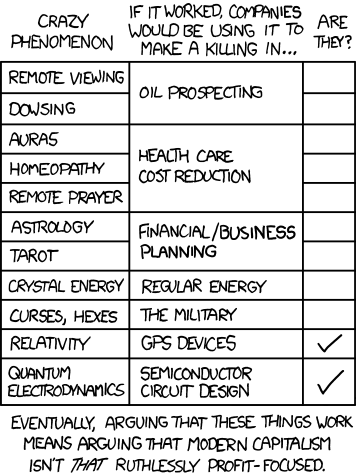
08 June 2010
Nature knows best.. erh so I guess we're idiots then?
"We live in a world where modern, educated women are choosing to have their babies at home, feed their children unpasteurized milk and then fail to get them immunized against potentially fatal diseases because a bimbo like Jenny McCarthy has convinced them that immunizations cause autism (They Don’t!). A common consequence of NIB as it plays out in society is that it can lead unwitting individuals to believe ridiculous things that, ironically, could not be further removed from true nature."
I'm mostly fine with the raw milk movement. Because that strikes me more as a right of contract issue (and a means of breaking a public milk moonopoly). Many of the improvements are things like the processing, moving, and storage of milk as well as the health of the cows themselves in addition to pasteurization. If that's a consumer choice, even if it doesn't offer any advantage, in that case, let them play with their stupidity. And I think I agree with the home delivery caveat as well. As long as people are prepared to turn over the situation when it goes awry to medical expertise, in the interest of saving lives, go right ahead and try if that's so important to you. The difference for these is that for the most part, people who buy raw milk are not harming anyone but themselves (just as someone should legally be able consume cigarettes or alcohol or anything else that could be harmful). And with the child birth as long as any we can use health care services to deal with obvious risks to the infant during birth, we don't really care how it gets delivered because it's not much of a harms issue. Vaccines are a public externalities and public harms issue. You don't get your kid vaccinated, that's not just a "you" problem. That's especially a risk to people whose kids cannot get vaccinated (too young or have current health problems), and a risk to, well everyone else even the people who have been vaccinated. It's a terrible free rider problem in that it has not only costs on everyone else, in that they have to pay for you to sit around and be relatively protected health wise by their herd immunity, but potentially inflicts grievous harms on them as well in the event you end up sick.
But the big point linking all those things is that they're scientific or modernizing. It's becoming one of the times where we've got the unusual problem as libertarians of being, at times (especially on the milk or home delivery, not so much on vaccines), useful idiots for the real idiots.
(We've also got global warming on this boat. At least there there's a debate over how best to resolve it, but not so much among the rabble though)
I'm mostly fine with the raw milk movement. Because that strikes me more as a right of contract issue (and a means of breaking a public milk moonopoly). Many of the improvements are things like the processing, moving, and storage of milk as well as the health of the cows themselves in addition to pasteurization. If that's a consumer choice, even if it doesn't offer any advantage, in that case, let them play with their stupidity. And I think I agree with the home delivery caveat as well. As long as people are prepared to turn over the situation when it goes awry to medical expertise, in the interest of saving lives, go right ahead and try if that's so important to you. The difference for these is that for the most part, people who buy raw milk are not harming anyone but themselves (just as someone should legally be able consume cigarettes or alcohol or anything else that could be harmful). And with the child birth as long as any we can use health care services to deal with obvious risks to the infant during birth, we don't really care how it gets delivered because it's not much of a harms issue. Vaccines are a public externalities and public harms issue. You don't get your kid vaccinated, that's not just a "you" problem. That's especially a risk to people whose kids cannot get vaccinated (too young or have current health problems), and a risk to, well everyone else even the people who have been vaccinated. It's a terrible free rider problem in that it has not only costs on everyone else, in that they have to pay for you to sit around and be relatively protected health wise by their herd immunity, but potentially inflicts grievous harms on them as well in the event you end up sick.
But the big point linking all those things is that they're scientific or modernizing. It's becoming one of the times where we've got the unusual problem as libertarians of being, at times (especially on the milk or home delivery, not so much on vaccines), useful idiots for the real idiots.
(We've also got global warming on this boat. At least there there's a debate over how best to resolve it, but not so much among the rabble though)
01 February 2010
with friends like these...
"Back in New York City, you can feel the tremors in the social bedrock, if not in the earth’s crust, as T. J. Randall would have it. An online video game, designed recently by libertarians in Brooklyn, called “2011: Obama’s Coup Fails” imagines a scenario in which the Democrats lose seventeen of nineteen seats in the Senate and a hundred and seventy-eight in the House during the midterm elections, prompting the President to dissolve the Constitution and implement an emergency North American People’s Union, with help from Mexico’s Felipe Calderón, Canada’s Stephen Harper, and various civilian defense troops with names like the Black Tigers, the International Service Union Empire, and CORNY, or the Congress of Rejected and Neglected Youth. Lou Dobbs has gone missing, Glenn Beck and Rush Limbaugh turn up dead at a FEMA concentration camp, and you, a lone militiaman in a police state where private gun ownership has been outlawed, are charged with defeating the enemies of patriotism, one county at a time."
Read more: http://www.newyorker.com/reporting/2010/02/01/100201fa_fact_mcgrath?currentPage=all#ixzz0eLRLEoTG
Very often I have to look at the political situation and wonder whether I am disenfranchised from it enough. And then I see stuff like that and I realize that apparently this is the closest thing most Americans have in their minds when they consider third party politics and arrangements. It isn't some philosophical assumptions that arrive them supporting a political party and system that doesn't exist anymore. It's more like a reactionary sentiment that is fueled by some sort of fear. The cynicism I have over the corporatism that influences and is influenced by Washington politics does not extend to spouting random conspiracy theories like those made popular in the X-Files during my youth, things like FEMA and the government is coming for your guns and NAFTA is there to sell us to the aliens in Mexico or Canada or whatever with some new North American government and secret black helicopters. X-Files is funny entertainment. It is not a coherent political message or agenda. When those are the sorts of people that people associate with "libertarianism", I have some serious reservations about my choices in political persuasions. Most of my own experiences within libertarian philosophy and its attending policy positions are with academics. Sometimes they propose things that look a little nutty or that will simply not happen. But they also don't sit around complaining about NAFTA and black helicopters and FEMA (except to say that usually private markets work better than the coordinated solutions of governments like FEMA).
I continue to look at the Tea Party movement as a joke, consisting largely of people engaged in a massive act of group therapy with an as yet incoherent political agenda or message. I would guess their diagnosis of the problems are boiled down to a simple "they're taking our country away" only it's unclear who the "they" is or which country they are talking about (it is abundantly clear that most of the people tending toward social conservatism within this movement haven't been anywhere outside their own intellectual bubbles to see what the rest of the country consists of). It does appear to have gotten its act together and figured out at least that all politics is local. It's not clear if it has figured out that voting against the other guy (which appears to be some of the motivations behind Scott Brown voters) is not a serious political movement. It will get some attention when it works, and when it fails (as in NY-23), but it will be difficult to take what is essentially a message about decentralization and create any sort of stable philosophy about the directions of government. This has been the problem of libertarianism as a general ideology for any party (especially the Libertarian Party) for decades. It will remain impossible if other attending demands again resurface as the economy continues its inevitable recoveries. It is pretty easy to get people of any stripes to coordinate their agitations when their jobs are threatened, or when the prospects for their children seem dimmer, because people are generally more pessimistic about the economy anyway than people who study it for a living. It will be much harder to govern based upon that agitation however.
What exactly do they want done for example? Even if it is "stop doing this, or that" rather than the alternatives of "pass health care reform" et al, you still need a way to enact a plan to stop doing this or that, from cutting the funding to voting against it. I haven't seen one to focus on what is one of the apparent primary concerns of tea partiers: the national debt and deficit spending. How do they plan to address the situation? We still don't know. Getting outside of the economic boxes, and into these bizarro worlds like gun control fears and conspiracy theories will not help. And that's basically inevitable. A country that gets its information filter primarily from google searches (that they themselves select where to go and what to look for) and muttering incoherent slogans about freedom is not very likely to have sensible ideas on the direction that that country is going in and how to arrest whatever problems they perceive.
A political movement like this appears to be gaining some sensibility and looks to be trying to kick Palin and other national figures to the curb. I think this is sensible, mostly because if Palin comes to be seen as "your" party or the voice of that movement, that whole movement is fucked. I think at its core much of the politics of the last 3 years or so suggests that many Americans have arrived at a conclusion that enough is enough and that the directions we have gone are incorrect, foolish, or dangerous. Some of that I would agree with. I don't see how Palin offers any hope to that, but to many disaffected people she does, by playing off their fears of elitism and technocratic decisions as are presently made. What they don't seem to realize is that she's basically the same tired agenda. She's not a fighter for some new agenda; she's the same agenda dressed up and calling it by a different name. I think this was true of Scott Brown and it appears, thus far, to be true of Obama. American voters are basically suckers and American politicians know this and profit by it, either by getting elected or by mouthing the words and getting paid directly (as Palin is doing). The difference I think between the tea partiers and me is that I look at Washington and don't ask how it got the way it did. I know how it gets that way: all you have to do if you live here is look in the damn mirror. You did this Americans. Take ownership of it. You demanded things and reacted when people promised them to you. You never started paying attention to see if they were followed up with. You caused the problem, not Washington bureaucracy and not Wall Street or Detroit's or the teacher's unions or anything else that seems now to be sleeping around in the political sense with each other.
Much of the libertarian philosophy relies on the idea that it is better not to give things too much central power and control, even supposedly rigid social morals, so that they can be flexible and adaptive, and so we can re-evaluate them when we need to change them. Social morals, like the complaints referenced in that piece about homosexuality for example, are thus better left not to politics and used to construct museums as testimonials to our beliefs (the better to allow them to be mocked and deconstructed by those that know how), but to individuals. I think this is usually offering some pretty consistent policies to governing. There are some exceptions, like public externalities, that require government or at least public interventions and negotiations to resolve. But you're better off leaving a lot of things to impersonal forces and not worrying too much when the country veers off in a direction you don't like. It may veer back later, or it may not matter very much to you personally. I don't understand social insistence on sexual conformity because nobody requires you to have sex with people you don't want to. I don't understand an insistence on religious observance for our political class because many people don't make such requirements in their daily lives and should know how hollow and fragile their commitments to their chosen faith really is. I don't understand resistance to ideas about the universe and its mechanisms for operation because these ideas have shown to be reasonably good interpretations of empirical evidence, but this is largely because I understand the empirical evidence as being reasonable and acknowledge its existence in the first place I suppose. To the extent that I worry about these things, it is not usually because there are lots of people who disagree with me on these points (that is admittedly troubling sometimes). It is because there are lots of people who disagree with me in the way of how to implement these things as public discourse and policies. I don't see why my kids, should I ever have any, should have to pray in school (if they don't want to, I don't plan on instructing kids about religion at all, if they want to I may ask some questions but that's about as far as I'm willing to go to frame their worldviews). Or why any friends who happen to be gay should have to conceal their sexuality and marry someone they do not love instead. Whose sensibilities are offended when these things happen? Nobody's. If you or your children are religious, you are welcome to instruct them to pray on their own time or to offer sanctimonious acknowledgments of the goodness or greatness of your personal god for your successes in public. If you aren't homosexual, you are welcome to find worthy and willing partners for your attempts at monogamous life-long happiness. You are not somehow altered into some demonic abomination or indecent power by allowing others to practice their freedoms (those that offer you and everyone you know no harms save some affront or offense, neither of which is a protected status under the law or at least, neither should be).
As a test of societies, I think it speaks much more highly when it is capable of tolerating its most outspoken ideas. I will admire the initiative of these anonymous weirdos in Brooklyn for building an imaginary land of fear and persecution for those who love their constitutional freedoms, much as X-Files was amusing. I'd prefer it if they didn't give others the impression that I was an ally in their cause by using a philosophy of classical liberalism as the title for their politics. But I am not one to squash their opinions and worldviews for suggesting that somehow ACORN is about to take over the US and put us on track for a super-country incorporating Mexico and Canada and so on. I think these opinions are dumb and unfounded. I don't know how to convince them that they are wrong. I've argued and tried using facts, but facts are ignored in a world where you can select your own. So it looks like the best option is to simply allow people to coordinate into their own groups and use decentralized sources of power. If they want to run a country or state or city on their basis, let them. I will find a place that will "run" it more to my liking instead.
Read more: http://www.newyorker.com/reporting/2010/02/01/100201fa_fact_mcgrath?currentPage=all#ixzz0eLRLEoTG
Very often I have to look at the political situation and wonder whether I am disenfranchised from it enough. And then I see stuff like that and I realize that apparently this is the closest thing most Americans have in their minds when they consider third party politics and arrangements. It isn't some philosophical assumptions that arrive them supporting a political party and system that doesn't exist anymore. It's more like a reactionary sentiment that is fueled by some sort of fear. The cynicism I have over the corporatism that influences and is influenced by Washington politics does not extend to spouting random conspiracy theories like those made popular in the X-Files during my youth, things like FEMA and the government is coming for your guns and NAFTA is there to sell us to the aliens in Mexico or Canada or whatever with some new North American government and secret black helicopters. X-Files is funny entertainment. It is not a coherent political message or agenda. When those are the sorts of people that people associate with "libertarianism", I have some serious reservations about my choices in political persuasions. Most of my own experiences within libertarian philosophy and its attending policy positions are with academics. Sometimes they propose things that look a little nutty or that will simply not happen. But they also don't sit around complaining about NAFTA and black helicopters and FEMA (except to say that usually private markets work better than the coordinated solutions of governments like FEMA).
I continue to look at the Tea Party movement as a joke, consisting largely of people engaged in a massive act of group therapy with an as yet incoherent political agenda or message. I would guess their diagnosis of the problems are boiled down to a simple "they're taking our country away" only it's unclear who the "they" is or which country they are talking about (it is abundantly clear that most of the people tending toward social conservatism within this movement haven't been anywhere outside their own intellectual bubbles to see what the rest of the country consists of). It does appear to have gotten its act together and figured out at least that all politics is local. It's not clear if it has figured out that voting against the other guy (which appears to be some of the motivations behind Scott Brown voters) is not a serious political movement. It will get some attention when it works, and when it fails (as in NY-23), but it will be difficult to take what is essentially a message about decentralization and create any sort of stable philosophy about the directions of government. This has been the problem of libertarianism as a general ideology for any party (especially the Libertarian Party) for decades. It will remain impossible if other attending demands again resurface as the economy continues its inevitable recoveries. It is pretty easy to get people of any stripes to coordinate their agitations when their jobs are threatened, or when the prospects for their children seem dimmer, because people are generally more pessimistic about the economy anyway than people who study it for a living. It will be much harder to govern based upon that agitation however.
What exactly do they want done for example? Even if it is "stop doing this, or that" rather than the alternatives of "pass health care reform" et al, you still need a way to enact a plan to stop doing this or that, from cutting the funding to voting against it. I haven't seen one to focus on what is one of the apparent primary concerns of tea partiers: the national debt and deficit spending. How do they plan to address the situation? We still don't know. Getting outside of the economic boxes, and into these bizarro worlds like gun control fears and conspiracy theories will not help. And that's basically inevitable. A country that gets its information filter primarily from google searches (that they themselves select where to go and what to look for) and muttering incoherent slogans about freedom is not very likely to have sensible ideas on the direction that that country is going in and how to arrest whatever problems they perceive.
A political movement like this appears to be gaining some sensibility and looks to be trying to kick Palin and other national figures to the curb. I think this is sensible, mostly because if Palin comes to be seen as "your" party or the voice of that movement, that whole movement is fucked. I think at its core much of the politics of the last 3 years or so suggests that many Americans have arrived at a conclusion that enough is enough and that the directions we have gone are incorrect, foolish, or dangerous. Some of that I would agree with. I don't see how Palin offers any hope to that, but to many disaffected people she does, by playing off their fears of elitism and technocratic decisions as are presently made. What they don't seem to realize is that she's basically the same tired agenda. She's not a fighter for some new agenda; she's the same agenda dressed up and calling it by a different name. I think this was true of Scott Brown and it appears, thus far, to be true of Obama. American voters are basically suckers and American politicians know this and profit by it, either by getting elected or by mouthing the words and getting paid directly (as Palin is doing). The difference I think between the tea partiers and me is that I look at Washington and don't ask how it got the way it did. I know how it gets that way: all you have to do if you live here is look in the damn mirror. You did this Americans. Take ownership of it. You demanded things and reacted when people promised them to you. You never started paying attention to see if they were followed up with. You caused the problem, not Washington bureaucracy and not Wall Street or Detroit's or the teacher's unions or anything else that seems now to be sleeping around in the political sense with each other.
Much of the libertarian philosophy relies on the idea that it is better not to give things too much central power and control, even supposedly rigid social morals, so that they can be flexible and adaptive, and so we can re-evaluate them when we need to change them. Social morals, like the complaints referenced in that piece about homosexuality for example, are thus better left not to politics and used to construct museums as testimonials to our beliefs (the better to allow them to be mocked and deconstructed by those that know how), but to individuals. I think this is usually offering some pretty consistent policies to governing. There are some exceptions, like public externalities, that require government or at least public interventions and negotiations to resolve. But you're better off leaving a lot of things to impersonal forces and not worrying too much when the country veers off in a direction you don't like. It may veer back later, or it may not matter very much to you personally. I don't understand social insistence on sexual conformity because nobody requires you to have sex with people you don't want to. I don't understand an insistence on religious observance for our political class because many people don't make such requirements in their daily lives and should know how hollow and fragile their commitments to their chosen faith really is. I don't understand resistance to ideas about the universe and its mechanisms for operation because these ideas have shown to be reasonably good interpretations of empirical evidence, but this is largely because I understand the empirical evidence as being reasonable and acknowledge its existence in the first place I suppose. To the extent that I worry about these things, it is not usually because there are lots of people who disagree with me on these points (that is admittedly troubling sometimes). It is because there are lots of people who disagree with me in the way of how to implement these things as public discourse and policies. I don't see why my kids, should I ever have any, should have to pray in school (if they don't want to, I don't plan on instructing kids about religion at all, if they want to I may ask some questions but that's about as far as I'm willing to go to frame their worldviews). Or why any friends who happen to be gay should have to conceal their sexuality and marry someone they do not love instead. Whose sensibilities are offended when these things happen? Nobody's. If you or your children are religious, you are welcome to instruct them to pray on their own time or to offer sanctimonious acknowledgments of the goodness or greatness of your personal god for your successes in public. If you aren't homosexual, you are welcome to find worthy and willing partners for your attempts at monogamous life-long happiness. You are not somehow altered into some demonic abomination or indecent power by allowing others to practice their freedoms (those that offer you and everyone you know no harms save some affront or offense, neither of which is a protected status under the law or at least, neither should be).
As a test of societies, I think it speaks much more highly when it is capable of tolerating its most outspoken ideas. I will admire the initiative of these anonymous weirdos in Brooklyn for building an imaginary land of fear and persecution for those who love their constitutional freedoms, much as X-Files was amusing. I'd prefer it if they didn't give others the impression that I was an ally in their cause by using a philosophy of classical liberalism as the title for their politics. But I am not one to squash their opinions and worldviews for suggesting that somehow ACORN is about to take over the US and put us on track for a super-country incorporating Mexico and Canada and so on. I think these opinions are dumb and unfounded. I don't know how to convince them that they are wrong. I've argued and tried using facts, but facts are ignored in a world where you can select your own. So it looks like the best option is to simply allow people to coordinate into their own groups and use decentralized sources of power. If they want to run a country or state or city on their basis, let them. I will find a place that will "run" it more to my liking instead.
01 November 2009
Gould
In science, 'fact' can only mean 'confirmed to such a degree that it would be perverse to withhold provisional assent.' I suppose that apples might start to rise tomorrow, but the possibility does not merit equal time in physics classrooms.
I'm confused as to how people take this level of doubt or uncertainty, more or less the <1% variety, and turn it into "scientists don't know anything". Philosophically that's a valuable sort of doubt and inquisitiveness to have, but for all practical purposes it is useless for most any human being to follow to its logical conclusions. It's even worse when the public moves from a mathematical law with constants behind it into a scientific theory with repeatable and observable experimentation behind that. More or less, if you're not the expert studying and experimenting and attempting to disprove a positive theoretical assertion, don't pretend that your doubts should always be taken seriously or should determine policies, particularly for other people.
One other note. People use this 99.9% instead of 100% logic frequently with religious belief and understanding versus scientific knowledge and understanding. This is not a fair comparison. Religious belief is more like scientific hypothesis because it is not based upon empirical, repeatable, and observable truths (there are some incredibly advantageous social science understandings that religious beliefs have picked up on over the centuries, but these aren't exactly universal effects in the same way that gravity, thermodynamics, or evolution are). More to the point, a significant portion of it suffers from entirely subjective vantage points and becomes even loony and dangerous (especially where it is used to justify internalized preferences and prejudices). And without some sort of empirical truth on which to rest those loony beliefs and appeal to a more reasoned approach, there's no countering force to sort them back out of the mainstream positions. The danger of a central empirical version of truth, unassailed by testing and reasoned debate over the facts as we observe them (and ideally we can agree on these as a starting point, in practice disagreement over the facts is incredibly common), is frequently just as bad as the lack of such a central version to appeal to. Given the propensity of authorities, secular and religious, to abuse their positions and powers historically. I'm still working out how to resolve this ambiguity in such a way that we can have some trust in knowledge as it advances and still be able to appeal to it when it has some certainty behind it. Without turning it into a religion either for the people who live that way or the people who perceive it as an opposition to their current religious institutions.
Because those atheists who start writing hymns to godlessness I think are really missing the point.
I'm confused as to how people take this level of doubt or uncertainty, more or less the <1% variety, and turn it into "scientists don't know anything". Philosophically that's a valuable sort of doubt and inquisitiveness to have, but for all practical purposes it is useless for most any human being to follow to its logical conclusions. It's even worse when the public moves from a mathematical law with constants behind it into a scientific theory with repeatable and observable experimentation behind that. More or less, if you're not the expert studying and experimenting and attempting to disprove a positive theoretical assertion, don't pretend that your doubts should always be taken seriously or should determine policies, particularly for other people.
One other note. People use this 99.9% instead of 100% logic frequently with religious belief and understanding versus scientific knowledge and understanding. This is not a fair comparison. Religious belief is more like scientific hypothesis because it is not based upon empirical, repeatable, and observable truths (there are some incredibly advantageous social science understandings that religious beliefs have picked up on over the centuries, but these aren't exactly universal effects in the same way that gravity, thermodynamics, or evolution are). More to the point, a significant portion of it suffers from entirely subjective vantage points and becomes even loony and dangerous (especially where it is used to justify internalized preferences and prejudices). And without some sort of empirical truth on which to rest those loony beliefs and appeal to a more reasoned approach, there's no countering force to sort them back out of the mainstream positions. The danger of a central empirical version of truth, unassailed by testing and reasoned debate over the facts as we observe them (and ideally we can agree on these as a starting point, in practice disagreement over the facts is incredibly common), is frequently just as bad as the lack of such a central version to appeal to. Given the propensity of authorities, secular and religious, to abuse their positions and powers historically. I'm still working out how to resolve this ambiguity in such a way that we can have some trust in knowledge as it advances and still be able to appeal to it when it has some certainty behind it. Without turning it into a religion either for the people who live that way or the people who perceive it as an opposition to their current religious institutions.
Because those atheists who start writing hymns to godlessness I think are really missing the point.
13 July 2009
Thoughts on the level of ad-targeting.
So when I click to look at the story on the new surgeon general (odd how many postings are done immediately and some are taking forever), the list of ads along the sidebar is as follows:
1) Colon Cleansers
2) lose 47 lbs
3) anti-aging creams
4) whiter teeth
5) lose 48 lbs
Would anyone think these are related beyond the abstract discussion of "health or health care"? A typical person interested in who the surgeon general is (or at least is likely to be) is probably not a person who is likely to purchase scam-like health products, diets, etc, even though they may very likely care more about their personal health or health care. In other words, they're are probably not the typical American person for whom such ads are likely to carry some effect.
I sympathize that advertising on the web isn't quite a full-fledged developed concept with immediate and likely buyers. Ad targeting as it were in ways that TV or radio could only dream of. But it's funny when it gets it wrong.
1) Colon Cleansers
2) lose 47 lbs
3) anti-aging creams
4) whiter teeth
5) lose 48 lbs
Would anyone think these are related beyond the abstract discussion of "health or health care"? A typical person interested in who the surgeon general is (or at least is likely to be) is probably not a person who is likely to purchase scam-like health products, diets, etc, even though they may very likely care more about their personal health or health care. In other words, they're are probably not the typical American person for whom such ads are likely to carry some effect.
I sympathize that advertising on the web isn't quite a full-fledged developed concept with immediate and likely buyers. Ad targeting as it were in ways that TV or radio could only dream of. But it's funny when it gets it wrong.
24 June 2009
science is fun
But TV ruins it.
So over the weekend, in between the helping administer the cleaning to a family estate sale, I caught a National Geographic thing on magnetic fields. Like all such shows today involving science, the apparent backdrop of explaining complex things like Van Allen Belts and magnetic navigation is "the end of the world".
So the show takes about a half hour explaining how the magnetic fields are created out of the molten core of the planet and that somehow the core is hardening and the magnetic field dying, takes a left turn and explains that the magnetic fields (polar north/south) change over time and have done so repeatedly by weakening the fields just like now, and that somehow the planet and its animals are in danger because of these gradual random and significant changes, and then there's one line tucked into the end of the show about how there's no proof linking such changes to mass extinctions (or any extinctions of any kind).
Much like anything the history channel does on mega disaster or the Mayan prophecies, it's ridiculous nonsense posing as arbiter of fate rather than scientific analysis or even hypothesis. But there is at least some scientific exposure placed in there, talking to the experts about how this stuff works. Then the editors get involved I guess. I would have imagined that NatGeo would be above such hype-based nonsense to attract attention, from my childhood experiences of reading about far away places and random scientific discoveries by naturalists and astronomers. But one imagines that there's at least somewhat less fact checking necessary to get at the actual material that the show presented in a less than honest and sensible fashion than has been the case with many many historical portrayals of prophetic events. We've seen similar problems with new technology like the LHC as though it's the end of the world. The types of changes exposed by studying things carefully and analytically can be revolutionary, but they're hardly the end of the world. Even the unlocking of the atom hasn't yet ended up as a doomsday scenario, and I was a child in the age when that was still considered a serious possibility (when a comic book like Watchmen can be written about it). That's still a formative memory of how human beings could at any moment decide to destroy each other by the millions. Something stops us. And it isn't some deities or even a deus ex machina plot device of some sort. Sometimes I think it's just better to be a force of creative influence than to destroy. Science doesn't seem to care one way or the other, which is probably a good thing.
So over the weekend, in between the helping administer the cleaning to a family estate sale, I caught a National Geographic thing on magnetic fields. Like all such shows today involving science, the apparent backdrop of explaining complex things like Van Allen Belts and magnetic navigation is "the end of the world".
So the show takes about a half hour explaining how the magnetic fields are created out of the molten core of the planet and that somehow the core is hardening and the magnetic field dying, takes a left turn and explains that the magnetic fields (polar north/south) change over time and have done so repeatedly by weakening the fields just like now, and that somehow the planet and its animals are in danger because of these gradual random and significant changes, and then there's one line tucked into the end of the show about how there's no proof linking such changes to mass extinctions (or any extinctions of any kind).
Much like anything the history channel does on mega disaster or the Mayan prophecies, it's ridiculous nonsense posing as arbiter of fate rather than scientific analysis or even hypothesis. But there is at least some scientific exposure placed in there, talking to the experts about how this stuff works. Then the editors get involved I guess. I would have imagined that NatGeo would be above such hype-based nonsense to attract attention, from my childhood experiences of reading about far away places and random scientific discoveries by naturalists and astronomers. But one imagines that there's at least somewhat less fact checking necessary to get at the actual material that the show presented in a less than honest and sensible fashion than has been the case with many many historical portrayals of prophetic events. We've seen similar problems with new technology like the LHC as though it's the end of the world. The types of changes exposed by studying things carefully and analytically can be revolutionary, but they're hardly the end of the world. Even the unlocking of the atom hasn't yet ended up as a doomsday scenario, and I was a child in the age when that was still considered a serious possibility (when a comic book like Watchmen can be written about it). That's still a formative memory of how human beings could at any moment decide to destroy each other by the millions. Something stops us. And it isn't some deities or even a deus ex machina plot device of some sort. Sometimes I think it's just better to be a force of creative influence than to destroy. Science doesn't seem to care one way or the other, which is probably a good thing.
02 June 2009
Magically Mystery Hypothesis
Yup. Definitely America
Not that stupid theories are wholly limited to an American convention, but we do have some of the best practitioners. Nimbly denying that evidence defies their ideas, and fails to support even the new and flimsy conventions instead. For example, I'm guessing Chrysler and GM basically used some sort of algorithm to decide which dealers got shut down. If somebody figured out what the basis for that algorithm was, then that's where the actual bias lies (presumably the less movement of product by percentage or raw value, and thus the more local competition, the less likely to stay open a dealer was). But even that might certainly correlate with some totally irrelevant thing, such as donations to Hillary Clinton or people who report being abducted by Martians and probed while they dismembered some cattle together. Or some such.
I often think of stuff like this whenever the history channel does its end of the world week or has a special on Illuminati/Knights Templar/Freemasons/Pyramid numerology. I just don't need to go through the statistical jargon and mental exercises to arrive at the conclusion that it's amusing and pointless conclusions being put forth by these people. The distressing part is the amount of people, including more mainstream media types than the sort that Faux employs, who buy into and purvey such bullshit assessments or distortions of reality to fit their worldview.
Not that stupid theories are wholly limited to an American convention, but we do have some of the best practitioners. Nimbly denying that evidence defies their ideas, and fails to support even the new and flimsy conventions instead. For example, I'm guessing Chrysler and GM basically used some sort of algorithm to decide which dealers got shut down. If somebody figured out what the basis for that algorithm was, then that's where the actual bias lies (presumably the less movement of product by percentage or raw value, and thus the more local competition, the less likely to stay open a dealer was). But even that might certainly correlate with some totally irrelevant thing, such as donations to Hillary Clinton or people who report being abducted by Martians and probed while they dismembered some cattle together. Or some such.
I often think of stuff like this whenever the history channel does its end of the world week or has a special on Illuminati/Knights Templar/Freemasons/Pyramid numerology. I just don't need to go through the statistical jargon and mental exercises to arrive at the conclusion that it's amusing and pointless conclusions being put forth by these people. The distressing part is the amount of people, including more mainstream media types than the sort that Faux employs, who buy into and purvey such bullshit assessments or distortions of reality to fit their worldview.
18 May 2009
Hats on the ringer. Or something needs to be said without a finger
So since the President can wander into the hornet's nest of a incoherent debate and make it sound presentable, so shall I attempt to make sense.
I've ranted previously on the problems with the framing of the debate surrounding abortion, particularly this false dichotomy of "pro-life/pro-abortion". That's not something I've changed my reasoning for. But I am willing to examine the relevant issues behind the curtain, so to speak.
What it comes down to ultimately is the ability of each individual person to exercise their conscience and make decisions. We recognize that these decisions carry unique and powerful consequences at times, and where these consequences are tragic, painful, and harmful to others, we often have the means and justification to step in and apply a measure of justice or judgment. The central argument of the "pro-life/anti-choice" side is that these harms apply to fertilized embryos and developing fetuses just as they would to any fully formed and helpless infant. Yet we have not established the criteria, either scientifically or metaphysically, for demonstrating what life (in the human sense) is and where on the time line that begins. Each person then is left to that decision themselves.
The supposition becomes that somehow permitting such decisions to be made without overriding legal scrutiny in their aftermath somehow abolishes the difficulty of making them. Or that abolishing the legality of these decisions also abolishes the practice. Neither is true, or ever has been. Procedures for abortions can still be performed in the absence of legality. Often less safely, often without trained medical care, and often at greater expense. But like any other demand we label as illicit, the demand still exists outside the boundaries of law. Likewise, it cannot be said that most women would choose such a path with greater and greater ease. Or in fact that they would often feel that have much of a choice at all in the absence of sensible alternatives (such as would be commonly available to say, the upper middle class with access to proper medical care and precautionary methods reducing the likelihood of making such a problematic situation arise in the first place versus the impoverished, undereducated classes of our society that have neither opportunity afforded them in a sufficiency worth contemplating).
Much as I find I despise the ordinary person, it seems best to afford them the maximum ability to determine their own courses, and to make every effort that that course should be less burdened. I do not say that people who hold a strong and discordant view must be silenced and led out of arenas when they express their dissatisfaction. But I do demand that they be respectful that not all hold their views and that there are reasonable positions that should be listened to, if not perhaps agreed with. Where there are sensible positions that are expressed I will listen. It seems to me the central goal of anti-abortion advocates is to lessen the frequency of such events. I see no reason that a policy cannot be devised to achieve this end, still falling short of legally penalizing the women who seek out abortions or doctors perform them. If that sort of goal is achieved (and in case "they" haven't been paying attention, the rate of abortions per pregnancy has been falling for at least the last 25 years), then I fail to see what the demands are about nor the consistency with which they are made in light of the expressed demands for "government to get out of our lives" in other avenues of life's strange and tumultuous exhibitions.
So to try to understand what these demands have been about, I engaged with those who hold them to try to get at their points of view:
1) Abortion is infanticide.
First off, infanticide is nothing new in both the historical and social spectrum. The ancient Romans and Greeks so often revered in American society were among its practitioners. It was often practiced as a means of population control in smaller societies with scarce public resources available and for which the survival of any extra person could mean starvation for the whole (and thus the questionable survival of a young and helpless infant to begin with). There are sound structural arguments to be made that the health of a society is threatened mightily by the introduction of large numbers of ill-cared for or undesired/unplanned children as the result of pregnancies that were not terminated (and for which a rational prospective mother might still retain a desire for children at a more appropriate time). Crime for example is strained by such an increase in what would psychologically be termed "at risk children". Educational systems, often from lower income areas already pushed beyond their ability to service their students, would likewise require social accommodations. If we are not willing to permit the exercise of choice to have children at a desirable time and ability for prospective parents, then are we not bound to consider the costs that such a cumulative and forcible imposition of our own societal choice has wrought for us at a later date? If we are not, then why would we wish to impose a cost on ourselves for which someone else could ably supply at some other time?
Secondly, and more pressing, it is still not possible to establish unquestionably that human life begins at conception. It doesn't even do this naturally. Every time a measure comes along attempting to punish the few unwilling parents who commit some atrocity to a newborn infant, sometimes after a failed abortion attempt, the laws as drafted are so draconian as to make little differentiation between the natural and tragic personal event of a miscarriage and that of a child killed, or a pregnancy terminated, by deliberate circumstances. Where the circumstances are obvious I should think there are laws and judgments to be made, and we can already make them (just as there used to be a convincing argument to be had regarding existing laws on terrorism, now swept aside in favor of torture, often by the same people who oppose abortion...consistency....consistency people). Where they are questionable surroundings, we may be able to question, but not to intrude with guns blazing.
We have not been able to craft definitive laws on these matters because our legal system has not definitively used a process to declare when a human being is endowed with these natural and unalienable rights prior to its natural live birth. It fundamentally cannot because that determination would make the presumption, however well intentioned and well-founded that may be, that all such developments will take their course and provide a living breathing infant and all the trials or tribulations, as well as joys and wonders, that accompany such things. They do not, even in the natural order. Were we to suggest that habits which increase the likelihood of a "natural" miscarriage, such as say smoking or drinking, be criminalized for a pregnant and prospective mother there would be, or at least one would expect, a public outcry equally divisive and suggesting of a troubling introduction of governmental meddling with the private affairs of its citizens. Simply being over 40 for example is a troubling condition for the development of a fetus into a healthy infant. How would we best attack this problem with the full force of legal powers to protect the developing child with society's blessing? Again we cannot. If we cannot protect and guarantee human life with every contraceptive event through legal authorities then I dare say we haven't yet found it's source in a scientific and metaphysical form. It would be a simple matter at that point. Since it is not a simple matter, it remains instead to allow individuals to exercise as best they may their conscience when the question is put forth in their own minds on how to proceed. For individuals who feel it is a simple matter, it becomes one. They don't have to have abortions. There is no formal or informal state policy of infanticide being adopted like that of the ancient Romans or even the more modern Chinese "one child" policy that is often pointed to with disdain. For everyone else, this decision remains challenging. And we are amazingly still free to make it more difficult still by disagreeing with a particular course of action. Even in public, but ideally without resorting to violence or judgmental acts of disrespect.
2) If we do not endow a fetus with human rights, what is stop someone from deciding freely through the exercise of their conscience that say, Mexicans, are not human and how would we be consistent to punish their actions. Here we have drawn clear legal distinctions. Once a person is alive through birth, we create legal structures as a means of guarding against things like unilateral intolerance and genocidal activity. Again, since there isn't a clear argument that a human being becomes such at the inception of a fertilized egg, there has to be a clear argument agreed upon socially that there is a point where a human being gains their human rights. There are vague legal opinions offered that this occurs at some time before birth and we legally prevent most abortions from occurring past that point, excepting in extreme cases for the health of a pregnant woman for example. At birth, we are permitted the activity of our mind in the pursuit of prejudicial opinions and biases. We are not permitted the depravity to slaughter or abuse others on the sole basis that we feel they are less human or not human. This is a silly point to have to make in a debate, but it comes up frequently made by ardent anti-abortion advocates. As though there is a distributed playbook to run down a series of ridiculous arguments with the idea being that only someone who holds these ridiculous opinions would oppose their viewpoint. It's not the only one
3) No distinction or quarter is to be made between people who allow abortions to go forward by not enacting laws to penalize anyone involved and the actual people who choose freely to have the procedure or to perform it. All are then painted with the broad stroke of "pro-abortion". Most accurately, the label is "pro-choice", with the understanding that a large percentage of such peoples would personally oppose many conditions for having abortions of their own. Even the women who would have them are often in a considerable state of doubt and uncertainty. "Roe" for example became opposed to abortion at a later point in her life. Judging from that sort of turnaround, it seems natural to allow consciences to be exercised free from legal scrutiny and consequence, but it would still be possible to do so with the opposition of society or with the support of its essential members (our friends or family). Such consequences are often more unbearable than anything we could assemble as a legal penalty to exact for a perceived injustice. As such, it remains to assemble a means to make these consequences more infrequent, by providing better and intelligent access to alternatives, and to use social infrastructures without the calcified and inflexible force of legal authoritarians to impose them more freely. They work. Legal authority simply guarantees a series of intractable consequences to the greater society that no one is prepared to deal with and does precious little to restrict the demands of people who would seek out abortions in whatever dire circumstances they feel necessary to have one. Rather it structurally limits who has access to them to precisely the same group that already has sufficient safeguards to limit the need in the first place: generally upper-middle classes of people.
4) Sex should not be "guilt-free" or without consequence.
It remains to understand that an advocacy structured on abstinence will generally fail to achieve its goals, because it often fails to educate responsibly its target audience, and that there is nothing inherently damaging about sex itself that we should be labeling it as a "guilt-free" activity where people must move to remove any perceived damages it creates upon its participants. This assumption that human sexuality outside of some sanctified marriage is somehow automatically bad is itself creating a good deal of social difficulty as it then creates legal and social distinctions on marriage itself (see: gay rights being limited). Sexuality carries already a good number of consequences in the form of transmittable disease risks. Pregnancy is, by comparison, the lesser concern, and also happens to be the concern that is by nature more private. Disease has social implications and costs to be managed by appropriate public response. One such response is to educate. Another is to demand accountable or responsible behavior. This response is based, strangely for what is largely a religious movement, on the ideal human behavior. One assumes that if human beings are largely unaccountable and prone to "sin", that there should be measures employed not merely to "prevent sin" but to account for any damages upon others. We do this in criminal acts and such people are often the first to demand stringent penalties, and yet there is no accountability for a baser human impulse toward sex? Would it not be sensible to assume, even though this is itself a flawed assumption on its face, that all people would seek to engage in sexual practices at some point almost certainly before we have some established social procedure that permits them to do so, at least without malicious intentions, and then design a policy that acts on this assumption? Why the dichotomy between some actions which can harm but one or a few (or even just the self in the form of our drug laws or attempts at "anti-homosexual"/sodomy laws for consensual adults, some of whom would be heterosexual married couples...) and actions which could harm many through ignorance or maliciousness equally?
When this sort of anti-intellectual, "god wills it" culture is subsided and replaced with a greater sense of personal accountability rather than "I will make you feel accountable because MY god says so", I think we'd have a more reasonable approach toward difficult subjects like abortion and I suspect we'd have a lot fewer abortions performed. The hypocritical double standards therein are, based on my previous post, precisely what is so offending people who leave their organized religious institutions behind and precisely why so many people in this country have stratified opinions on this subject that make it virtually impossible to have a coherent debate. Fortunately for all of us so long as there isn't a coherent debate, there won't be much in the form of legal activity. Maybe the discordant shouting is what we all wanted in the first place and so long as there won't be any policies getting made one way or the other, then it's a tossup whether anything will be getting done or not. So we can continue shouting.
I've ranted previously on the problems with the framing of the debate surrounding abortion, particularly this false dichotomy of "pro-life/pro-abortion". That's not something I've changed my reasoning for. But I am willing to examine the relevant issues behind the curtain, so to speak.
What it comes down to ultimately is the ability of each individual person to exercise their conscience and make decisions. We recognize that these decisions carry unique and powerful consequences at times, and where these consequences are tragic, painful, and harmful to others, we often have the means and justification to step in and apply a measure of justice or judgment. The central argument of the "pro-life/anti-choice" side is that these harms apply to fertilized embryos and developing fetuses just as they would to any fully formed and helpless infant. Yet we have not established the criteria, either scientifically or metaphysically, for demonstrating what life (in the human sense) is and where on the time line that begins. Each person then is left to that decision themselves.
The supposition becomes that somehow permitting such decisions to be made without overriding legal scrutiny in their aftermath somehow abolishes the difficulty of making them. Or that abolishing the legality of these decisions also abolishes the practice. Neither is true, or ever has been. Procedures for abortions can still be performed in the absence of legality. Often less safely, often without trained medical care, and often at greater expense. But like any other demand we label as illicit, the demand still exists outside the boundaries of law. Likewise, it cannot be said that most women would choose such a path with greater and greater ease. Or in fact that they would often feel that have much of a choice at all in the absence of sensible alternatives (such as would be commonly available to say, the upper middle class with access to proper medical care and precautionary methods reducing the likelihood of making such a problematic situation arise in the first place versus the impoverished, undereducated classes of our society that have neither opportunity afforded them in a sufficiency worth contemplating).
Much as I find I despise the ordinary person, it seems best to afford them the maximum ability to determine their own courses, and to make every effort that that course should be less burdened. I do not say that people who hold a strong and discordant view must be silenced and led out of arenas when they express their dissatisfaction. But I do demand that they be respectful that not all hold their views and that there are reasonable positions that should be listened to, if not perhaps agreed with. Where there are sensible positions that are expressed I will listen. It seems to me the central goal of anti-abortion advocates is to lessen the frequency of such events. I see no reason that a policy cannot be devised to achieve this end, still falling short of legally penalizing the women who seek out abortions or doctors perform them. If that sort of goal is achieved (and in case "they" haven't been paying attention, the rate of abortions per pregnancy has been falling for at least the last 25 years), then I fail to see what the demands are about nor the consistency with which they are made in light of the expressed demands for "government to get out of our lives" in other avenues of life's strange and tumultuous exhibitions.
So to try to understand what these demands have been about, I engaged with those who hold them to try to get at their points of view:
1) Abortion is infanticide.
First off, infanticide is nothing new in both the historical and social spectrum. The ancient Romans and Greeks so often revered in American society were among its practitioners. It was often practiced as a means of population control in smaller societies with scarce public resources available and for which the survival of any extra person could mean starvation for the whole (and thus the questionable survival of a young and helpless infant to begin with). There are sound structural arguments to be made that the health of a society is threatened mightily by the introduction of large numbers of ill-cared for or undesired/unplanned children as the result of pregnancies that were not terminated (and for which a rational prospective mother might still retain a desire for children at a more appropriate time). Crime for example is strained by such an increase in what would psychologically be termed "at risk children". Educational systems, often from lower income areas already pushed beyond their ability to service their students, would likewise require social accommodations. If we are not willing to permit the exercise of choice to have children at a desirable time and ability for prospective parents, then are we not bound to consider the costs that such a cumulative and forcible imposition of our own societal choice has wrought for us at a later date? If we are not, then why would we wish to impose a cost on ourselves for which someone else could ably supply at some other time?
Secondly, and more pressing, it is still not possible to establish unquestionably that human life begins at conception. It doesn't even do this naturally. Every time a measure comes along attempting to punish the few unwilling parents who commit some atrocity to a newborn infant, sometimes after a failed abortion attempt, the laws as drafted are so draconian as to make little differentiation between the natural and tragic personal event of a miscarriage and that of a child killed, or a pregnancy terminated, by deliberate circumstances. Where the circumstances are obvious I should think there are laws and judgments to be made, and we can already make them (just as there used to be a convincing argument to be had regarding existing laws on terrorism, now swept aside in favor of torture, often by the same people who oppose abortion...consistency....consistency people). Where they are questionable surroundings, we may be able to question, but not to intrude with guns blazing.
We have not been able to craft definitive laws on these matters because our legal system has not definitively used a process to declare when a human being is endowed with these natural and unalienable rights prior to its natural live birth. It fundamentally cannot because that determination would make the presumption, however well intentioned and well-founded that may be, that all such developments will take their course and provide a living breathing infant and all the trials or tribulations, as well as joys and wonders, that accompany such things. They do not, even in the natural order. Were we to suggest that habits which increase the likelihood of a "natural" miscarriage, such as say smoking or drinking, be criminalized for a pregnant and prospective mother there would be, or at least one would expect, a public outcry equally divisive and suggesting of a troubling introduction of governmental meddling with the private affairs of its citizens. Simply being over 40 for example is a troubling condition for the development of a fetus into a healthy infant. How would we best attack this problem with the full force of legal powers to protect the developing child with society's blessing? Again we cannot. If we cannot protect and guarantee human life with every contraceptive event through legal authorities then I dare say we haven't yet found it's source in a scientific and metaphysical form. It would be a simple matter at that point. Since it is not a simple matter, it remains instead to allow individuals to exercise as best they may their conscience when the question is put forth in their own minds on how to proceed. For individuals who feel it is a simple matter, it becomes one. They don't have to have abortions. There is no formal or informal state policy of infanticide being adopted like that of the ancient Romans or even the more modern Chinese "one child" policy that is often pointed to with disdain. For everyone else, this decision remains challenging. And we are amazingly still free to make it more difficult still by disagreeing with a particular course of action. Even in public, but ideally without resorting to violence or judgmental acts of disrespect.
2) If we do not endow a fetus with human rights, what is stop someone from deciding freely through the exercise of their conscience that say, Mexicans, are not human and how would we be consistent to punish their actions. Here we have drawn clear legal distinctions. Once a person is alive through birth, we create legal structures as a means of guarding against things like unilateral intolerance and genocidal activity. Again, since there isn't a clear argument that a human being becomes such at the inception of a fertilized egg, there has to be a clear argument agreed upon socially that there is a point where a human being gains their human rights. There are vague legal opinions offered that this occurs at some time before birth and we legally prevent most abortions from occurring past that point, excepting in extreme cases for the health of a pregnant woman for example. At birth, we are permitted the activity of our mind in the pursuit of prejudicial opinions and biases. We are not permitted the depravity to slaughter or abuse others on the sole basis that we feel they are less human or not human. This is a silly point to have to make in a debate, but it comes up frequently made by ardent anti-abortion advocates. As though there is a distributed playbook to run down a series of ridiculous arguments with the idea being that only someone who holds these ridiculous opinions would oppose their viewpoint. It's not the only one
3) No distinction or quarter is to be made between people who allow abortions to go forward by not enacting laws to penalize anyone involved and the actual people who choose freely to have the procedure or to perform it. All are then painted with the broad stroke of "pro-abortion". Most accurately, the label is "pro-choice", with the understanding that a large percentage of such peoples would personally oppose many conditions for having abortions of their own. Even the women who would have them are often in a considerable state of doubt and uncertainty. "Roe" for example became opposed to abortion at a later point in her life. Judging from that sort of turnaround, it seems natural to allow consciences to be exercised free from legal scrutiny and consequence, but it would still be possible to do so with the opposition of society or with the support of its essential members (our friends or family). Such consequences are often more unbearable than anything we could assemble as a legal penalty to exact for a perceived injustice. As such, it remains to assemble a means to make these consequences more infrequent, by providing better and intelligent access to alternatives, and to use social infrastructures without the calcified and inflexible force of legal authoritarians to impose them more freely. They work. Legal authority simply guarantees a series of intractable consequences to the greater society that no one is prepared to deal with and does precious little to restrict the demands of people who would seek out abortions in whatever dire circumstances they feel necessary to have one. Rather it structurally limits who has access to them to precisely the same group that already has sufficient safeguards to limit the need in the first place: generally upper-middle classes of people.
4) Sex should not be "guilt-free" or without consequence.
It remains to understand that an advocacy structured on abstinence will generally fail to achieve its goals, because it often fails to educate responsibly its target audience, and that there is nothing inherently damaging about sex itself that we should be labeling it as a "guilt-free" activity where people must move to remove any perceived damages it creates upon its participants. This assumption that human sexuality outside of some sanctified marriage is somehow automatically bad is itself creating a good deal of social difficulty as it then creates legal and social distinctions on marriage itself (see: gay rights being limited). Sexuality carries already a good number of consequences in the form of transmittable disease risks. Pregnancy is, by comparison, the lesser concern, and also happens to be the concern that is by nature more private. Disease has social implications and costs to be managed by appropriate public response. One such response is to educate. Another is to demand accountable or responsible behavior. This response is based, strangely for what is largely a religious movement, on the ideal human behavior. One assumes that if human beings are largely unaccountable and prone to "sin", that there should be measures employed not merely to "prevent sin" but to account for any damages upon others. We do this in criminal acts and such people are often the first to demand stringent penalties, and yet there is no accountability for a baser human impulse toward sex? Would it not be sensible to assume, even though this is itself a flawed assumption on its face, that all people would seek to engage in sexual practices at some point almost certainly before we have some established social procedure that permits them to do so, at least without malicious intentions, and then design a policy that acts on this assumption? Why the dichotomy between some actions which can harm but one or a few (or even just the self in the form of our drug laws or attempts at "anti-homosexual"/sodomy laws for consensual adults, some of whom would be heterosexual married couples...) and actions which could harm many through ignorance or maliciousness equally?
When this sort of anti-intellectual, "god wills it" culture is subsided and replaced with a greater sense of personal accountability rather than "I will make you feel accountable because MY god says so", I think we'd have a more reasonable approach toward difficult subjects like abortion and I suspect we'd have a lot fewer abortions performed. The hypocritical double standards therein are, based on my previous post, precisely what is so offending people who leave their organized religious institutions behind and precisely why so many people in this country have stratified opinions on this subject that make it virtually impossible to have a coherent debate. Fortunately for all of us so long as there isn't a coherent debate, there won't be much in the form of legal activity. Maybe the discordant shouting is what we all wanted in the first place and so long as there won't be any policies getting made one way or the other, then it's a tossup whether anything will be getting done or not. So we can continue shouting.
31 December 2007
genital integrity
http://freakonomics.blogs.nytimes.com/2007/12/31/first-the-bagel-now-the-mohel/
Whatever that phrase means, it's rather amusing.
I'd have to wonder as well why the circumcision rate is so high. Or, if I was to be culturally ignorant, ask why it's so low in the Western portions of the country by comparison (probably because the population is predominated by Latinos). Supposedly there were medical reasons to have this done, or at least, there are medical 'experts' who claim it should be done. Some of these even sound legitimate (things like a less-bacterial prone environment). But I'd have to ask, why if this is so 'good' do we call it mutilation when a woman is circumcised? It seems to me that it's fairly well mutilation either way. Doing the circumcision seems like removing someone's tonsils when there's nothing wrong with them. On the plus side, it does seem like the religious ritualistic aspects are fading. But they're being justified with mixed scientific views now instead. It always amazes me when religion and science become allies. (Intelligent design anyone?).
Whatever that phrase means, it's rather amusing.
I'd have to wonder as well why the circumcision rate is so high. Or, if I was to be culturally ignorant, ask why it's so low in the Western portions of the country by comparison (probably because the population is predominated by Latinos). Supposedly there were medical reasons to have this done, or at least, there are medical 'experts' who claim it should be done. Some of these even sound legitimate (things like a less-bacterial prone environment). But I'd have to ask, why if this is so 'good' do we call it mutilation when a woman is circumcised? It seems to me that it's fairly well mutilation either way. Doing the circumcision seems like removing someone's tonsils when there's nothing wrong with them. On the plus side, it does seem like the religious ritualistic aspects are fading. But they're being justified with mixed scientific views now instead. It always amazes me when religion and science become allies. (Intelligent design anyone?).
08 February 2007
complex systems
There's a difference between science and complexity. Its a gap that hasn't been easily closed. Science has observed its first major gains in places such as botany, astronomy, physics, chemistry. These are places where the bulk of study is observation, analysis, experimentation, and so forth. It is relatively easy to observe, describe, and calculate the interactions of a relatively linear system with few objects or forces involved.
It has become a frustrated method as its studies have progressed and the systems have grown larger and more complex. This began with atomic studies and the ideas of quantum mechanics. As time bears on, fluid dynamics, genetics, and the weather still escape our scientific inquisition at times. We can observe wind or water, but it is often difficult to predict exactly how it will interact with any reliability. This is because there are a great many interactions involved. Each has a minor and seemingly irrelevant part to play. Each ends up in unpredictability. The weather and the stock market are two places we try to invent algorithms to predict and give us a measured stability. We fail. It isn't because science is necessarily bad. It is because it doesn't understand living systems very well. One of the hallmarks of science is to break down a reaction and see how each part plays into the final result. But a living system doesn't have necessarily a consistent result. One can mix two chemicals at such and such pressure/volume/temperature, and the same result will evolve of this circumstance every time. This doesn't happen. The same two events in a living system can evolve into vastly different scenarios. Because minute variations become harmonies along the numerous interplays involved. If we're trying to break down such a system, we are ignoring two aspects.
First, the system often depends on its interplay for any results. It almost has to be studied as a whole unit, not as a series of interactions that are scarcely related. They are related because they amplify or dampen each other along the way. We can't study this way with science. It can observe and document, but it's only barely coming to grips with the complexity involved. We've been trying to predict the weather for at least 70 years with advanced technology like radar. We're still wrong much of the time.
Second, if we begin breaking down such a complex situation, we're altering the conditions. We have no control over the variables in the experiment. Remember even minute variations cause disturbed harmonies. Heisenberg Uncertainty says much about this problem. If we try to measure an atomic particle's speed, well we're changing its position or energy, and if we're measuring its position, then its speed changes. A sociologist or psychologist observing subjects will witness altering behavior patterns to fit something approximating societal norms. People act differently when they know they're being watched. These are complex situations. We can't study them by being detached observers, because the situation doesn't allow us to sit back and play non-interference.
So now what? Science is useless? No, its pretty important still. It just doesn't have the answers we want yet. Because it is difficult work ahead. Put it back into its comfortable zone of linear equations and we would be done by now. We're not so lucky.
Subscribe to:
Posts (Atom)


 Posts
Posts

